
Deepfake Investment Scam 2026: Warning Signs You Must Know
Elon Musk, Warren Buffett, Martin Lewis — none of them have ever endorsed the platforms their AI-generated likenesses are selling. The deepfake investment scam 2026 is the most technologically sophisticated financial fraud ever deployed, and it defeats every traditional rule about trusting what you see.
⚡ Quick Summary — Deepfake Investment Scam 2026
- What it is: the deepfake investment scam 2026 uses AI-generated video of celebrities, financial experts, and politicians to drive social media traffic to fraudulent trading platforms
- The scale: AI-enabled fraud caused over $25 billion in global losses in 2025, with 2026 projections significantly higher
- How it reaches you: targeted Facebook, Instagram, YouTube, TikTok, and X advertisements followed by a “personal investment adviser” phone call
- The defining sign: a celebrity endorsing an investment platform through a paid social media advertisement — never through their verified official channels
- The golden rule: verify every celebrity endorsement through their official accounts, check every platform on the FCA/SEC register before depositing — no exceptions
⚠️ Already Deposited on a “Celebrity-Endorsed” Platform?
Stop immediately. Make no further deposits. The balance shown is not real, and any “tax” or “compliance” fee demanded to release funds will not unlock anything — every fee paid simply adds to your total loss. Contact your bank, block the adviser’s number, and jump to the What to Do If You Have Been Targeted section below.
📋 Table of Contents
- What Is the Deepfake Investment Scam 2026?
- How It Works, Step by Step
- Deepfake Investment Scam 2026 Variants
- Deepfake Investment Scam 2026 Warning Signs
- Real Stories: How It Destroys Finances
- What Authorities Say
- How to Protect Yourself
- What to Do If You Have Been Targeted
- Where to Report It
- Frequently Asked Questions
- Related Scam Guides
What Is the Deepfake Investment Scam 2026
The deepfake investment scam 2026 is a category of financial fraud that uses AI-generated video, audio, or image content to create false endorsements of fraudulent investment platforms by real, recognisable public figures. The term “deepfake” refers to AI-synthesised media in which a person’s likeness — their face, voice, and mannerisms — is digitally manipulated to make them appear to say or do something they never actually said or did. In the context of investment fraud, deepfake technology is used to create convincing videos of celebrities, billionaires, politicians, and financial experts appearing to personally recommend a trading platform, cryptocurrency fund, or investment opportunity that is entirely fraudulent.
The deepfake investment scam 2026 operates through a combination of advanced AI content generation and high-volume social media advertising. Criminals create a deepfake video — which may take as little as a few hours using widely available AI tools — and then pay for it to be distributed as a targeted advertisement on Facebook, Instagram, YouTube, TikTok, and X. The advertisement reaches millions of users who have shown interest in investment, finance, or the specific celebrity being impersonated. A fraction of viewers click through to the fraudulent platform, invest, and lose their money. Even a fraction of a percent of millions of impressions represents thousands of victims.
What makes the deepfake investment scam 2026 uniquely dangerous is the complete absence of any reliable visual detection method available to ordinary consumers. Professional deepfake detection tools exist and are used by media organisations and law enforcement agencies, but no consumer-facing tool can reliably identify AI-generated video in real time with sufficient accuracy to protect against the deepfake investment scam 2026. Consumers are therefore entirely dependent on awareness of the scam’s existence and consistent application of verification habits — rather than any technological detection capability. The same deepfake technology that powers this scam is dissected in our AI deepfake scams guide, and the crypto-specific variant is in our crypto investment scam 2026 guide.
How It Works, Step by Step
Almost every deepfake investment scam 2026 follows the same six-stage pattern, from AI-generated endorsement through to the withdrawal block and platform disappearance.
Step 1: Creating the Deepfake Endorsement
The deepfake investment scam 2026 begins in a production environment where criminals use AI deepfake tools to generate video content featuring a real public figure. Source material — video footage of the target individual — is fed into an AI system that synthesises new video showing them speaking words and making facial expressions that match a script written by the scammer. The most advanced deepfake investment scam 2026 operations also clone the target’s voice using AI audio synthesis, producing audio that is indistinguishable from genuine recordings of the same person. The figures most commonly impersonated include technology billionaires, prominent investors, television financial presenters, politicians, and sports celebrities. The choice of impersonation target is deliberate — the more trusted and recognisable the individual, the more convincing the apparent endorsement.
Step 2: Distributing the Content Through Paid Advertising
Once the deepfake content is created, the deepfake investment scam 2026 distributes it at scale through paid social media advertising. The advertisements are targeted precisely using platform algorithms — reaching users who have shown interest in investment, cryptocurrency, stock trading, personal finance, or the specific celebrity being impersonated. The advertisement appears in the feed of millions of users, many of whom have a pre-existing positive disposition toward the impersonated figure and are therefore significantly more likely to view the apparent endorsement as credible. The operators pay for these advertisements using cryptocurrency or stolen payment credentials, making it extremely difficult to trace the spend. When one advertisement is reported and removed, new variations using slightly different content are immediately uploaded to continue the campaign.
Step 3: The Landing Page and Registration
Viewers who click on a deepfake investment scam 2026 advertisement are taken to a landing page that continues the apparent endorsement narrative. The page typically features the deepfake celebrity’s image, fabricated quotes and testimonials, and a professionally designed interface presenting the investment platform. The platform name may incorporate the celebrity’s name or reference the apparent endorsement — “Musk Capital”, “Buffett Trading”, or similar. A registration form captures the victim’s name, email, and phone number — which are immediately used to make contact through a follow-up call from a “personal investment adviser.”
Step 4: The Personal Adviser Call
Within hours of registering, victims of the deepfake investment scam 2026 receive a call from a well-spoken, apparently professional investment adviser who follows up on the registration and encourages them to make an initial deposit. The adviser is trained to answer questions about the platform convincingly, to reference the celebrity endorsement as establishing credibility, and to create urgency through limited-time promotional rates or rapidly closing investment windows. The personal adviser is the human face of the deepfake investment scam 2026 — the technological component gets victims to the platform, but the human relationship closes the investment and maintains victim engagement through subsequent escalation calls.
Step 5: The Fake Dashboard and Growing Returns
Once an initial deposit is made, the deepfake investment scam 2026 platform shows impressive returns on a fake dashboard — a web interface displaying fabricated account balances, trading activity, and profit charts that are entirely controlled by the operators. The victim watches their investment apparently grow, which encourages larger subsequent deposits encouraged by the adviser. Some victims are allowed to make small withdrawals at this stage to confirm the platform’s legitimacy — these withdrawals are real payments made by the operators specifically to maintain the victim’s confidence.
Step 6: The Withdrawal Block and Collapse
When the victim attempts to withdraw a significant amount — or when the deepfake investment scam 2026 operators decide maximum extraction has been achieved — withdrawals are blocked. The victim is told they must pay a tax liability, a compliance fee, or a platform verification charge before funds can be released. Each fee payment is met with further fees. Eventually the platform disappears, the adviser becomes unreachable, and every dollar deposited is gone. The deepfake endorsement that started the entire process was entirely fabricated — the celebrity never endorsed any investment platform. The same withdrawal-trap mechanic underpins our crypto investment scams guide.
Deepfake Investment Scam 2026 Variants
5 VariantsThe deepfake investment scam 2026 adapts to whichever trust relationship the criminal can fabricate — celebrity, news anchor, politician, voice clone, or fake news article. These are the five most reported variants.
Celebrity Crypto Endorsement Scam
The most widespread deepfake investment scam 2026Financial Expert TV Endorsement
A broadcast-mimicking deepfake investment scam 2026Political Leader Endorsement
An authority-based deepfake investment scam 2026AI Voice Clone Phone Scam
A personalised deepfake investment scam 2026Fake News Article Scam
A print-mimicking deepfake investment scam 2026Deepfake Investment Scam 2026 Warning Signs
🚩 Deepfake Investment Scam 2026 Red Flags
- Any celebrity endorsing an investment platform through social media. Genuine celebrity investment endorsements are not delivered through social media advertisements. Any video of a celebrity recommending a trading platform through a paid advertisement should be treated as a probable deepfake investment scam 2026 until independently verified.
- Subtle visual anomalies in video content. Look for unnatural blinking patterns, slight lip-sync inconsistencies, blurring around the face or hairline, unusually smooth or plastic-looking skin texture, and lighting that does not match the apparent environment. These are common artefacts of the deepfake investment scam 2026 video generation process.
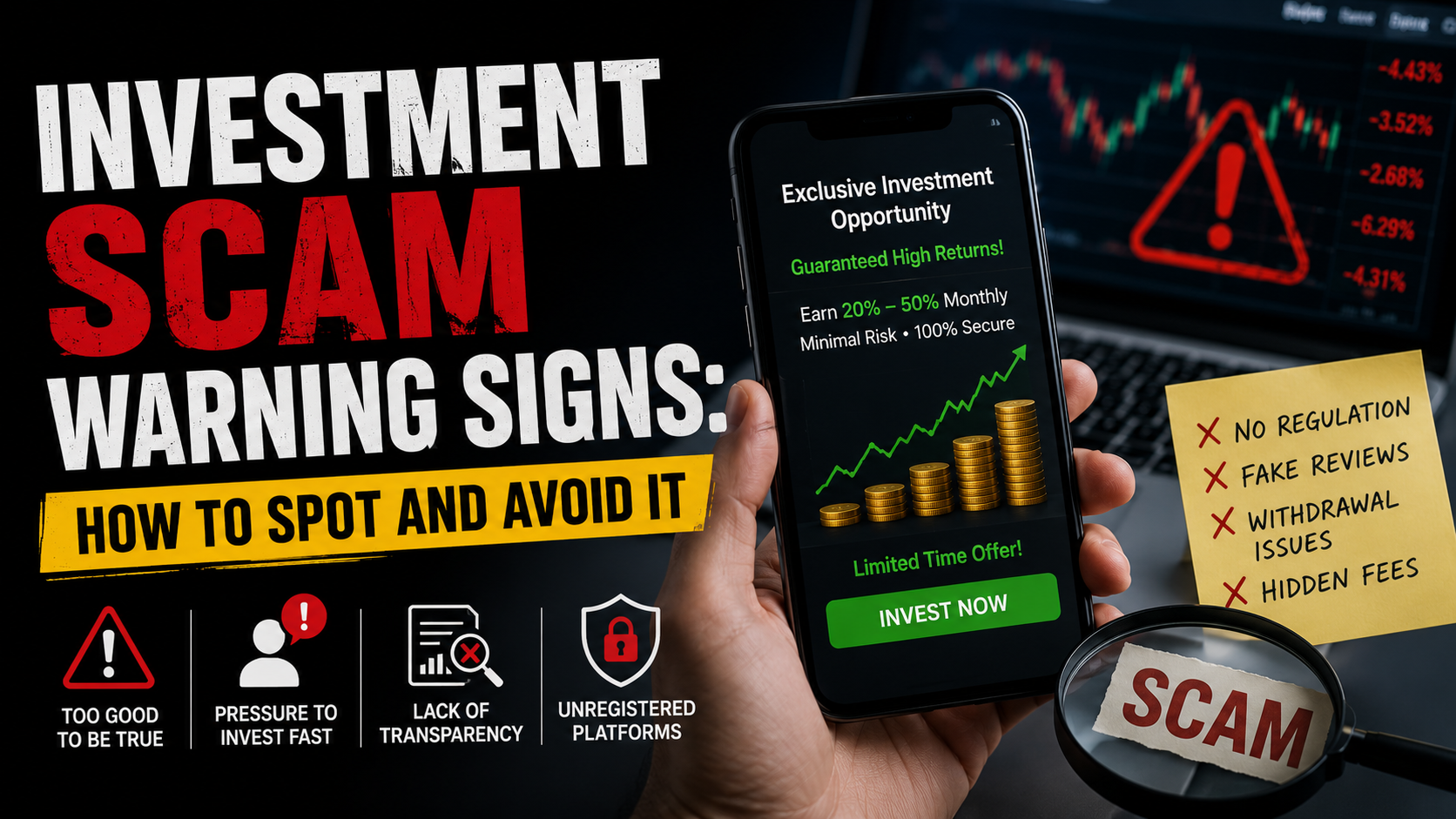
- Guaranteed or exceptionally high investment returns. No legitimate investment guarantees returns. Any platform offering consistent double-digit monthly returns — regardless of who appears to endorse it — is almost certainly a deepfake investment scam 2026.
- A platform not listed on regulatory registers. Before depositing any money, check the platform against the FCA register, SEC database, or equivalent regulatory body in your country. An unregistered platform is almost certainly a deepfake investment scam 2026.
- Withdrawal blocked unless additional fees are paid. Legitimate investment platforms deduct fees from withdrawals — they never require you to send additional money to release your funds. Any withdrawal fee demand is a definitive sign of the deepfake investment scam 2026.
- A personal adviser calling very quickly after registration. Receiving a persuasive phone call from an investment adviser within hours of registering on a platform discovered through a celebrity endorsement advertisement is a consistent feature of the deepfake investment scam 2026.
- Urgency to invest before a window closes. Time pressure and FOMO are standard manipulation tactics of the deepfake investment scam 2026. Genuine investment opportunities do not expire within hours.
- The celebrity’s official channels show no mention of the endorsement. If a celebrity is genuinely endorsing an investment platform, they will promote it through their verified official social media accounts. The complete absence of any mention on official channels is definitive proof that the endorsement is a deepfake investment scam 2026.
Real Stories: How It Destroys Finances
The Retiree and the Fake Elon Musk Video
The deepfake investment scam 2026 reaches retirees through highly targeted social media ads. A sixty-four-year-old retiree saw a Facebook advertisement featuring what appeared to be Elon Musk speaking directly to camera about a new AI-powered cryptocurrency trading platform. The video was highly convincing — the lip movements matched the audio, the voice sounded genuine, and the content referenced real recent events in Musk’s public life to establish authenticity. He clicked through, registered, and received a call from a professional-sounding investment adviser within two hours. He invested £12,000 from his pension savings. The dashboard showed his balance growing to £31,000 within three weeks. When he attempted to withdraw £20,000 to help pay for his daughter’s wedding, he was told a £4,800 tax compliance fee was required first. He paid it. A further £6,200 platform verification fee followed. He refused to pay further and the platform disappeared. Total loss: £23,000. Elon Musk had made no such video — it was entirely AI-generated as part of the deepfake investment scam 2026.
The Professional Investor Caught by a Fake News Segment
The deepfake investment scam 2026 fools even experienced investors. A forty-eight-year-old financial professional — someone with genuine investment experience — encountered a YouTube pre-roll advertisement that appeared to show a BBC financial news segment in which a well-known consumer finance journalist described exceptional returns from a new trading platform. The segment mimicked the BBC’s visual identity perfectly, including the channel’s graphics package and ticker format. The journalist shown was real; the content was entirely fabricated using the deepfake investment scam 2026 technology. He invested $45,000 — a significant but not unusual amount for someone of his investment experience. When the withdrawal block occurred and fees were demanded, his professional knowledge finally identified the pattern of the deepfake investment scam 2026. He refused further payments and reported the fraud to the FTC and SEC. He lost $45,000 and described the experience as “the most sophisticated fraud I have ever encountered — and I work in finance.”
The Couple Who Lost Their Home Deposit
The deepfake investment scam 2026 weaponises government authority to devastating effect. A couple in their early thirties saw an Instagram advertisement featuring a video of a prominent national politician apparently announcing a new government-backed investment programme offering guaranteed returns to first-time investors. The production quality was high — the politician’s voice, mannerisms, and speech patterns were accurately reproduced by the deepfake investment scam 2026 operators. They invested £18,000 — their entire saved house deposit — believing the government endorsement made the investment risk-free. Their apparent balance grew to £42,000 within six weeks. When they attempted to withdraw to complete a house purchase, they were told a £5,500 HMRC compliance fee was required. They borrowed the fee from family and paid it. The platform disappeared two days later. Total loss: £23,500 — their house deposit and the borrowed fee. The politician shown in the video had made no such announcement. Their home purchase collapsed.
What Authorities Say
The deepfake investment scam 2026 has prompted urgent action and warnings from financial regulators, law enforcement agencies, and technology platforms across the world — all of whom recognise it as a qualitatively new threat that existing consumer protection frameworks were not designed to address.
The Financial Conduct Authority in the United Kingdom has issued specific consumer warnings about deepfake investment advertisements, advising consumers never to invest based on a social media advertisement featuring a celebrity endorsement without independently verifying the endorsement through the celebrity’s official channels and checking the platform’s FCA registration. The FCA maintains a warning list of fraudulent investment platforms at fca.org.uk.
The Securities and Exchange Commission in the United States has issued investor alerts specifically addressing AI-generated investment fraud content, warning that deepfake technology is being used to create false endorsements that are indistinguishable from genuine footage. The SEC advises consumers to verify all investment platforms through its EDGAR database and to treat any celebrity-endorsed investment opportunity discovered through social media as high-risk until independently verified. Review guidance at investor.gov.
The Federal Bureau of Investigation has published consumer guidance specifically addressing the deepfake investment scam 2026 and AI-enabled financial fraud, noting the rapid growth of deepfake technology adoption by organised criminal networks. The FBI accepts reports at ic3.gov.
Europol has identified AI-enabled financial fraud — including the deepfake investment scam 2026 — as one of the most significant emerging threats to European consumers, noting that the technology has lowered the barrier to entry for sophisticated financial fraud to the point where it is accessible to criminal networks of all sizes. Europol’s consumer resources are available at europol.europa.eu.
How to Protect Yourself
Verify Every Celebrity Endorsement Through Official Channels
Before taking any action based on a celebrity investment endorsement seen in a social media advertisement, verify it directly through the celebrity’s verified official social media accounts, official website, and major news coverage. If a celebrity is genuinely endorsing an investment platform, they will promote it prominently through their own channels. The complete absence of any mention on official channels — which is invariably the case with the deepfake investment scam 2026 — is definitive proof that the endorsement is fabricated. This verification step takes two minutes and defeats every variant.
Check Every Platform Against Regulatory Registers
Before depositing any money on an investment platform — regardless of who appears to endorse it — check it against the relevant financial regulator’s register. In the UK, check the FCA register at fca.org.uk. In the US, check the SEC’s EDGAR system and FINRA’s BrokerCheck. A platform not appearing in these registers has no legal authorisation to offer investment services and is almost certainly a deepfake investment scam 2026. This check takes under five minutes and is the most reliable protection available.
Look for Deepfake Visual Artefacts
While no visual detection method is fully reliable against the most advanced deepfake investment scam 2026 content, several visual artefacts are common in AI-generated video. Look for unnatural blinking — either too frequent or too infrequent — slight inconsistencies between lip movement and audio, blurring or softening at the edges of the face, hair that appears unusually smooth or static, and lighting inconsistencies between the face and the background. Pause the video and examine still frames if possible — artefacts that are invisible in motion are often visible in a freeze frame. The same visual signals are documented in our AI deepfake scams guide.
Never Invest Based Solely on a Social Media Advertisement
No responsible investment decision should be made based on a social media advertisement — deepfake or otherwise. Genuine investment opportunities are found through regulated advisers, established financial institutions, and independently verified research — not through Facebook advertisements featuring celebrities. Apply this rule consistently and the deepfake investment scam 2026 cannot reach you regardless of how convincing the video content appears.
Consult an Independent Financial Adviser
Before making any significant investment — particularly one discovered through social media or recommended by an online contact — consult an independent, regulated financial adviser who has no connection to the opportunity being recommended. A qualified adviser will immediately identify the warning signs of the deepfake investment scam 2026 and protect you from a potentially devastating financial loss. The cost of an independent advisory consultation is trivial compared to the average loss in a deepfake investment scam 2026 case.
Report Deepfake Advertisements to the Platform
If you see a social media advertisement that you believe is part of the deepfake investment scam 2026 — featuring a celebrity endorsement of an investment platform — report it immediately using the platform’s ad reporting tool. Select “scam or fraud” as the reason. Also report it to the relevant financial regulator and to the FTC or Action Fraud. Your report contributes to the removal of the advertisement and the investigation of the criminal operation behind it.
What to Do If You Have Been Targeted
If you recognise that you are involved in a deepfake investment scam 2026, act fast. The steps below give you the best chance of limiting damage and supporting the investigation.
Stop all deposits immediately
If you recognise that you are involved in a deepfake investment scam 2026, stop making any further deposits immediately — regardless of what the platform shows as your current balance or what the adviser tells you about completing requirements to unlock your funds. The balance on the dashboard is not real. Every additional deposit goes directly to the criminals and cannot be recovered.
Contact your bank immediately
Contact your bank or card provider immediately and report every transaction made to the fraudulent platform. Ask whether any funds can be recalled or blocked. If you paid by credit card, initiate a chargeback. If you transferred cryptocurrency, contact the exchange’s fraud team. Speed is critical — the faster you act, the better the chance of any recovery from the deepfake investment scam 2026.
Report to financial regulators and law enforcement
UK victims should report to the FCA at fca.org.uk and Action Fraud at actionfraud.police.uk. US victims should report to the SEC at sec.gov/tcr, the FBI at ic3.gov, and the FTC at reportfraud.ftc.gov. Provide all available evidence — platform URLs, advertisement screenshots, transaction records, and all communications with the scammer.
Beware of recovery scams
After reporting your loss publicly, you may be approached by individuals claiming they can recover your funds from the deepfake investment scam 2026 for an upfront fee. This is always a second-layer fraud targeting the same victims. No private service can guarantee cryptocurrency or investment recovery. Report any recovery scam approach to the FTC and Action Fraud immediately.
Share your experience to protect others
Share your account of the deepfake investment scam 2026 on consumer forums, the BBB Scam Tracker, Reddit, and social media. Be specific about which celebrity was impersonated, what platform was involved, how the scam operated, and how much was lost. Public accounts build the awareness that is currently the only reliable consumer protection against this fraud.
Where to Report It
Reporting the deepfake investment scam 2026 helps regulators track AI-enabled fraud, helps platforms remove deepfake advertisements, and helps the next person to see the same advertisement recognise the pattern. Use the body that matches your country and situation.
Frequently Asked Questions
Think You have Been Scammed?
Act fast — stop depositing, contact your bank, then report it to the FCA, SEC, FBI, or Action Fraud.




One response to “Deepfake Investment Scam 2026: Warning Signs You Must Know”
[…] Despite the new tactics, the core investment fraud warning signs remain consistent. Guaranteed returns. Pressure to act fast. An adviser or platform you cannot independently verify. The same playbook drives our investment scam warning signs guide and powers specific variants like the crypto investment scam 2026 and the deepfake investment scam 2026. […]