Credit Card Interest Rate Scam: How to Spot and Avoid It
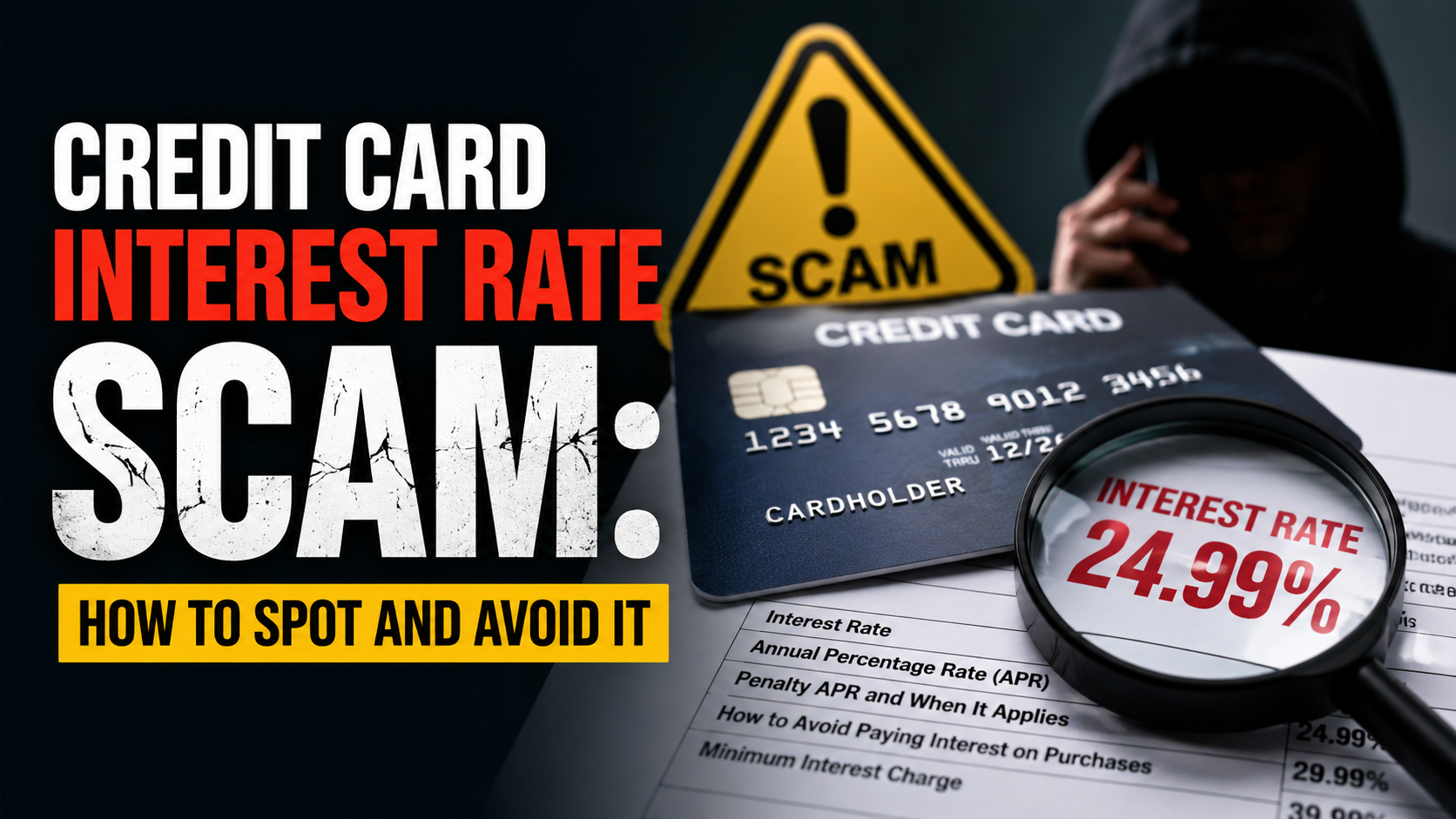
A robocall promises to slash your credit card interest rate — even to zero. The credit card interest rate scam preys on people struggling with debt, charging upfront fees for nothing. Here is how it works and how to shut it down.
⚡ Quick Summary — Credit Card Interest Rate Scam
- What it is: the credit card interest rate scam uses unsolicited robocalls and messages to offer dramatic rate reductions, then charges an upfront fee and delivers nothing
- Who it targets: people genuinely struggling with high-interest credit card debt — the offer is emotionally resonant for those under real financial stress
- The core red flag: an unsolicited offer to lower your rate, plus a demand for an upfront fee before any work is done
- How they take your money: upfront “processing fees” of $499–$2,999, plus card details harvested for further fraud
- The golden rule: you can ask your card issuer for a rate cut yourself for free — no legitimate service charges upfront, and zero percent through a third party is not real
⚠️ Already Paid an “Enrolment Fee”?
If you have paid a fee or shared card details with a credit card interest rate scam, contact your bank or card provider immediately to start a chargeback and protect any card whose details you shared. Then jump to the What to Do If You Have Been Targeted section below for the full step-by-step recovery process.
📋 Table of Contents
- What Is the Credit Card Interest Rate Scam?
- How the Credit Card Interest Rate Scam Works, Step by Step
- Credit Card Interest Rate Scam Variants
- Credit Card Interest Rate Scam Warning Signs
- Real Stories: How It Affects Real People
- What Authorities Say
- What Actually Works on High Rates
- How to Protect Yourself
- What to Do If You Have Been Targeted
- Where to Report It
- Frequently Asked Questions
- Related Scam Guides
What Is the Credit Card Interest Rate Scam
The credit card interest rate scam is a fraud in which criminals — posing as debt relief companies, credit card negotiation services, or financial assistance organisations — contact consumers with an unsolicited offer to negotiate a dramatic reduction in their credit card interest rates. The offer typically promises to lower rates to zero percent or a very low fixed rate, saving the consumer thousands of dollars in interest over the life of their balance, in exchange for an upfront fee.
The fundamental deception is twofold. First, the service being offered — negotiating interest rate reductions with credit card companies — is either something consumers can do themselves for free directly with their card issuer, or something that legitimate nonprofit credit counselling agencies can assist with at no cost or very low cost. Second, the dramatic rate reductions promised — particularly zero percent offers — are not realistic outcomes of the negotiation process described. Credit card companies do not reduce interest rates to zero simply because a third party calls to request it.
The credit card interest rate scam has been operating for decades — the FTC has taken enforcement action against numerous companies running this scheme — but it persists because the turnover of victims is high, the upfront fees extracted are significant, and the cost of operating the scam has been dramatically reduced by automated robocall technology that allows criminals to contact millions of people at minimal cost. In its most sophisticated modern form, the scam also harvests card details under the guise of “processing” the rate reduction — using this information for further financial fraud.
How It Works, Step by Step
Almost every version of the credit card interest rate scam follows the same six-stage pattern, from the first robocall to the deliberately obstructed refund.
Step 1: The Robocall or Unsolicited Contact
The credit card interest rate scam typically begins with an automated robocall — a pre-recorded message that reaches the victim’s phone with no warning. The recording claims to be from a rate reduction service, a debt relief organisation, or sometimes directly from a specific credit card company, and states that the recipient has been specifically selected for a special interest rate reduction programme — sometimes citing a recent change in law or a limited-time offer — and instructs them to press a number to speak with a specialist. Some variants use live callers, or follow an initial robocall with a live agent trained in sales techniques. The call may display a spoofed caller ID showing a legitimate-seeming business name or even the name of a real financial institution.
Step 2: The Personalised Pitch
When the consumer engages, the credit card interest rate scam transitions into a personalised sales pitch. The caller typically asks for details about the consumer’s current credit card balances and interest rates — information used both to personalise the pitch and to identify whether the consumer is a sufficiently valuable target. Higher balances mean higher apparent savings from the promised rate reduction, which makes the upfront fee seem more justifiable. The pitch emphasises the total interest the consumer is paying annually and quotes specific dollar figures — sometimes quite accurately calculated from the information just provided — making the offer feel precise, professional, and genuinely valuable.
Step 3: The Upfront Fee Demand
The core mechanism of the credit card interest rate scam is the upfront fee. After establishing the apparent value of the service, the caller requests payment of a fee — typically ranging from $499 to $2,999 depending on the total balance being “negotiated” — before any work is done. It is described as a processing charge, a negotiation fee, a programme enrolment cost, or an administrative expense. The scam depends on this payment being made before the consumer discovers that nothing of value will be delivered. Note that the Telemarketing Sales Rule in the US specifically prohibits debt relief companies from charging fees before they have actually delivered the promised service — making the upfront fee structure illegal under federal law.
Step 4: Harvesting Card Details
To collect the upfront fee, the credit card interest rate scam operator requests the consumer’s full credit card details. In many cases the scammer also requests the details of the card whose rate is supposedly being negotiated — under the pretext of needing this information to contact the card issuer on the consumer’s behalf. These card details are then used for additional unauthorised charges beyond the agreed fee, or sold to criminal networks specialising in card fraud.
Step 5: Nothing Is Delivered
After the fee is paid and card details are collected, the credit card interest rate scam delivers nothing. In some cases the scammer makes a brief, ineffective call to the credit card company — which produces no rate reduction — before providing the consumer with a report claiming the negotiation was unsuccessful due to their credit profile. In other cases no contact with the card issuer is made at all, and communication simply ends. The interest rate remains unchanged, the fee is unrecoverable, and additional unauthorised charges may appear on the card details provided.
Step 6: Pursuing the Refund Is Made Deliberately Difficult
When the consumer attempts to obtain a refund — having discovered that no rate reduction was achieved — the credit card interest rate scam company makes this as difficult as possible. They may claim the negotiation was attempted but unsuccessful, that the consumer’s credit profile disqualified them, or that the service was delivered as promised and no refund is owed. The company may be difficult to contact, may have no physical address, or may have simply disappeared. The consumer’s only realistic recourse is typically a credit card chargeback — which may succeed if initiated quickly enough.
Credit Card Interest Rate Scam Variants
5 VariantsThe credit card interest rate scam is not a single fraud but a family of related variants — each credit card interest rate scam variant works a little differently. These are the five most common.
The Classic Robocall Scam
The most prevalent credit card interest rate scam variantThe Bank Impersonation Variant
A credit card interest rate scam posing as your bankThe Debt Relief Programme Scam
A broader credit card interest rate scamThe Zero Percent Balance Transfer Scam
Charging for a free productThe SMS and Email Variant
A credit card interest rate scam by textCredit Card Interest Rate Scam Warning Signs
🚩 Credit Card Interest Rate Scam Red Flags
- An unsolicited call, text, or email about lowering your credit card interest rate. No legitimate credit card company contacts customers unsolicited about interest rate reductions. Any such unsolicited contact is the primary warning sign of the credit card interest rate scam.
- A robocall that instructs you to press a number. Robocalls offering to lower your credit card rate are illegal in the US under FTC regulations and are a defining feature of this scam. Hang up immediately without pressing any number.
- A promise to reduce your rate to zero percent. Credit card companies do not reduce interest rates to zero percent through third-party negotiation services. This specific zero percent promise is a hallmark of the credit card interest rate scam.
- A request for an upfront fee before any service is delivered. Under the FTC’s Telemarketing Sales Rule, debt relief companies are prohibited from collecting fees before delivering the promised service. Any upfront fee request is both illegal and a definitive red flag.
- A request for your full credit card details. No legitimate negotiation service needs your full card number, expiry date, and CVV to contact your card issuer on your behalf. Providing these details to a credit card interest rate scam operator enables further fraudulent charges.
- Urgency — the offer expires today or is a limited-time programme. Time pressure is a standard credit card interest rate scam tactic designed to prevent you from researching the company or consulting your card issuer before paying the fee.
- The company cannot be independently verified. Legitimate financial services companies are registered with relevant regulators and have verifiable track records. A company that cannot be found in regulatory databases, or has only very recent uniformly positive reviews, is almost certainly running the credit card interest rate scam.
- They claim special relationships or inside connections with card companies. No legitimate third-party company has a special arrangement with credit card issuers that gives them access to rates unavailable to you directly. This claim is a fabrication used to justify the fee.
Real Stories
The Single Parent and the Robocall
The credit card interest rate scam often reaches people at their most financially stretched. A single mother of two received a robocall claiming she had been selected for a special programme that could reduce her combined credit card interest rates from an average of 22% to just 6%, saving her over $4,000 annually. She was carrying $18,000 in credit card debt across three cards — accumulated during a period of reduced income — and the apparent saving of $4,000 per year was genuinely significant to her budget. She pressed the number and was connected with a professional-sounding agent who calculated her exact annual interest savings and explained the negotiation process convincingly. She paid a fee of $799 by credit card. Over the following six weeks she received no updates, no confirmation of any negotiation activity, and no rate reduction. When she tried to contact the company, the phone number was disconnected. She filed a chargeback and recovered the $799, but the credit card interest rate scam had cost her six weeks of stress and the false hope of financial relief she genuinely needed.
The Retiree Who Lost £1,400
The credit card interest rate scam also targets older consumers. A sixty-nine-year-old retiree received a call from someone claiming to be from his credit card company, saying he had been identified as a long-standing customer eligible for a special interest rate reduction programme. The caller knew his name and the approximate balance on his main card — information they may have obtained from a data breach or social engineering. He paid a fee of £1,400 to enrol in the programme. No rate reduction ever occurred. When his son helped him contact his genuine credit card company, they confirmed they had no record of any special programme and had not initiated the call. The phone number used by the credit card interest rate scam was disconnected, and the company name did not appear in any regulatory database. His bank could not recover the £1,400 because the payment had been made by bank transfer rather than credit card. He lost the full amount permanently.
The Professional Who Provided Card Details
A thirty-five-year-old marketing manager received a text message claiming she had been pre-approved for a zero percent balance transfer on her existing credit card balance of $9,500. The link led to a professional website where she completed a form providing her name, address, current card details including the full card number and CVV, and bank account details for the supposed transfer. She paid a processing fee of $299. Within 48 hours, three fraudulent charges totalling $1,840 appeared on the card whose details she had provided. No balance transfer was ever arranged, and the website’s support email never responded. The credit card interest rate scam had used the promise of debt relief to harvest her full card details — which were used immediately for additional fraud. Her bank reversed the fraudulent charges but could not recover the $299 processing fee.
What Authorities Say
The credit card interest rate scam has been specifically addressed by the FTC, the CFPB, and consumer protection bodies in both the US and UK — all delivering the same core message about the credit card interest rate scam.
The Federal Trade Commission has addressed the credit card interest rate scam in consumer alerts and enforcement actions over many years — most recently in an April 2026 alert that warned consumers to say “no, thanks” to unexpected offers to lower credit card interest rates. The FTC’s guidance is explicit: if a company calls you unexpectedly and offers to help lower your credit card interest rate, it is probably a scammer hoping you will pay them for shortcuts that do not really exist. Review FTC guidance at consumer.ftc.gov/scams and report fraud at reportfraud.ftc.gov.
Under the FTC’s Telemarketing Sales Rule, it is illegal for debt relief companies — including credit card interest rate negotiation services — to charge fees before they have actually provided the promised service. The upfront fee structure of the credit card interest rate scam is therefore not just deceptive but explicitly prohibited under federal law, and consumers who have paid upfront fees may be entitled to refunds.
Action Fraud in the UK has documented similar schemes operating under the guise of debt management and rate negotiation services, and warns that genuine debt advice is available free of charge through organisations including the Money and Pensions Service, Citizens Advice, and StepChange. Report UK variants at actionfraud.police.uk or call 0300 123 2040.
The Consumer Financial Protection Bureau accepts complaints about debt relief companies and credit card services and has taken enforcement action against companies running the credit card interest rate scam. File complaints at consumerfinance.gov/complaint.
What Actually Works on High Rates
The problem the credit card interest rate scam claims to address — high credit card interest — is genuinely real and genuinely affects millions of people. The scam exploits a legitimate need. But the legitimate solutions are available directly, for free, without paying any third party. Here is what actually works.
Call Your Card Issuer Directly
The most direct and effective approach to reducing your credit card interest rate — and the one the credit card interest rate scam falsely claims to perform on your behalf — is simply calling your card issuer directly and asking for a rate reduction. Card issuers frequently reduce rates for customers who ask, particularly those with a good payment history. This call costs nothing, takes fifteen minutes, and is something any consumer can do without paying any third party.
Contact a Nonprofit Credit Counselling Agency
Legitimate nonprofit credit counselling agencies — including those accredited by the National Foundation for Credit Counseling in the US and the Money and Pensions Service in the UK — can assist with debt management plans, interest rate negotiations, and budgeting support at no cost or very low cost. These organisations provide the genuine version of the service the credit card interest rate scam falsely promises. Find accredited agencies through the NFCC at nfcc.org in the US and through MoneyHelper at moneyhelper.org.uk in the UK.
Consider a Genuine Balance Transfer
Zero percent balance transfer credit cards — the product the credit card interest rate scam claims to arrange for a fee — are widely available directly from card issuers at standard balance transfer fees of 2% to 3%. Applying for a balance transfer card directly through a card issuer’s website costs nothing beyond that standard fee and produces the genuine product the scam falsely promises. Compare offers through reputable comparison sites before applying.
How to Protect Yourself
Hang Up on Robocalls Immediately
If you receive a robocall offering to lower your credit card interest rate, hang up immediately without pressing any number — including numbers supposedly offered to remove yourself from the calling list. Pressing any number confirms your line is active and may result in additional scam calls. The credit card interest rate scam robocall is illegal in the US under FTC regulations — you have no obligation to engage with it in any way.
Never Pay Upfront Fees for Debt Relief Services
This rule eliminates the financial risk of the credit card interest rate scam entirely. No legitimate debt relief service collects fees before delivering results — and under the FTC’s Telemarketing Sales Rule, doing so is illegal for companies that contact consumers by phone. If any company asks for an upfront fee to begin a credit card interest rate negotiation, you are dealing with the credit card interest rate scam — end the interaction immediately and report it.
Never Give Card Details to an Unsolicited Caller
Never provide your full credit card number, expiry date, or CVV to anyone who has contacted you unsolicited — regardless of who they claim to be or what service they claim to be providing. The credit card interest rate scam uses card details both to charge the upfront fee and to make additional unauthorised purchases. Protecting your card details from unsolicited callers prevents both the direct fee loss and the subsequent card fraud. This is the same discipline covered in our guide to the bank impersonation phone scam.
Register With the Do Not Call Registry
US consumers can register their phone numbers with the National Do Not Call Registry at donotcall.gov to reduce the volume of unsolicited telemarketing calls — including credit card interest rate scam robocalls. While this does not eliminate all scam calls — criminal operations frequently ignore Do Not Call registrations — it reduces the overall volume of unsolicited commercial calls and provides a legal basis for reporting violations.
Recognise the Pressure Tactics
The credit card interest rate scam relies on urgency, exclusivity, and emotional appeal to push you past the point of careful thought. Any caller who needs you to decide right now, who claims the offer is unique to you, or who leans on the stress of your debt is using the standard playbook seen across many imposter scams. Slowing down is itself a defence.
What to Do If You Have Been Targeted
If you have already paid a fee or shared card details with a credit card interest rate scam company, act quickly to limit the damage. The steps below give you the best chance of recovering money and limiting the damage.
Contact your bank or card provider immediately
If you paid an upfront fee using a credit card, contact your card provider immediately and initiate a chargeback — explain that you paid for a service, credit card interest rate negotiation, that was not delivered as promised. Chargebacks are frequently successful in these cases, particularly when initiated promptly. If you provided the full details of another card to the scammer, contact that card issuer immediately to report potential fraud and request a replacement card.
Report to the FTC and CFPB
File a complaint with the FTC at reportfraud.ftc.gov and with the CFPB at consumerfinance.gov/complaint. Provide the company name, phone number, website if applicable, the amount paid, and a description of what was promised and what was delivered. The FTC and CFPB use these complaints to build enforcement cases that have resulted in consumer refunds.
Report to Action Fraud (UK) or your national consumer authority
UK victims should report to Action Fraud at actionfraud.police.uk and to the Financial Conduct Authority if the company claimed to be a regulated financial services firm. Australian consumers should report to the ACCC’s Scamwatch at scamwatch.gov.au.
Monitor the card whose details you shared
If you gave the scammer the details of any card, watch that account closely for unauthorised charges and report anything you do not recognise to the issuer immediately. Requesting a replacement card with a new number is the safest course — the credit card interest rate scam routinely uses harvested details for further fraud days or weeks later.
Access genuine debt help
If you are carrying high-interest credit card debt and were approached because that debt is a genuine pressure, access genuine help through legitimate channels. In the US contact the NFCC at nfcc.org; in the UK contact StepChange at stepchange.org or Citizens Advice at citizensadvice.org.uk. These organisations provide free, professional debt management support — the genuine version of what the credit card interest rate scam falsely promises.
Where to Report It
Reporting the credit card interest rate scam helps authorities build enforcement cases against the operators behind the credit card interest rate scam. Use the body that matches your country and situation.
Frequently Asked Questions
Think You have Been Scammed?
Act fast — contact your bank, then report it through the official channels.