Tax Refund Text Scam: How to Spot and Avoid It
A fake text or email says your tax refund is waiting — but the tax refund text scam exists to steal your money and identity. Here is exactly how the tax refund text scam works, every variant in circulation, and how to protect yourself from it.
⚡ Quick Summary — Tax Refund Text Scam
- What it is: the tax refund text scam is a smishing/phishing fraud — fake texts or emails impersonating the IRS, HMRC or other tax agencies claiming you have a refund to claim
- Who it targets: anyone, but the tax refund text scam peaks during tax filing season when millions are genuinely expecting refunds
- The core red flag: the message contains a link to “claim” your refund — real tax agencies never do this
- How they take your money: a fake tax portal harvests your card details, bank details and identity information
- The golden rule: never click a link in a text or email about a tax refund — go directly to the official government website instead
⚠️ Already Entered Your Details?
If you entered card or bank details on a fake tax refund site, contact your bank immediately to cancel the card and watch for unauthorised direct debits. If you submitted your Social Security or National Insurance number, jump straight to the What to Do If You Have Been Targeted section below.
📋 Table of Contents
- What Is the Tax Refund Text Scam?
- How the Tax Refund Text Scam Works, Step by Step
- Tax Refund Text Scam Variants
- Tax Refund Text Scam Warning Signs
- Real Stories: How It Affects Real People
- What Tax Authorities Say
- How to Protect Yourself
- What to Do If You Have Been Targeted
- Where to Report It
- Frequently Asked Questions
- Related Scam Guides
What Is the Tax Refund Text Scam
The tax refund text scam is a smishing and phishing fraud in which criminals send fake text messages or emails impersonating tax authorities — the Internal Revenue Service in the United States, HMRC in the United Kingdom, the ATO in Australia, or other national tax agencies — claiming that the recipient has a tax refund available to claim. In every version of the tax refund text scam, the message contains a link to a fraudulent website designed to harvest the victim’s personal information, financial details, or login credentials, which are then used for identity theft, financial fraud, or further targeted phishing.
Tax impersonation is not new, but the tax refund text scam in its current form is. What changed in 2026 is the scale, sophistication, and year-round nature of the fraud. Modern tax refund text scam operations use professional-grade phishing infrastructure, AI-generated personalised messages, sender ID spoofing that makes messages appear to come from official tax agency shortcodes, and highly convincing fake websites that are visually identical to genuine tax portal pages.
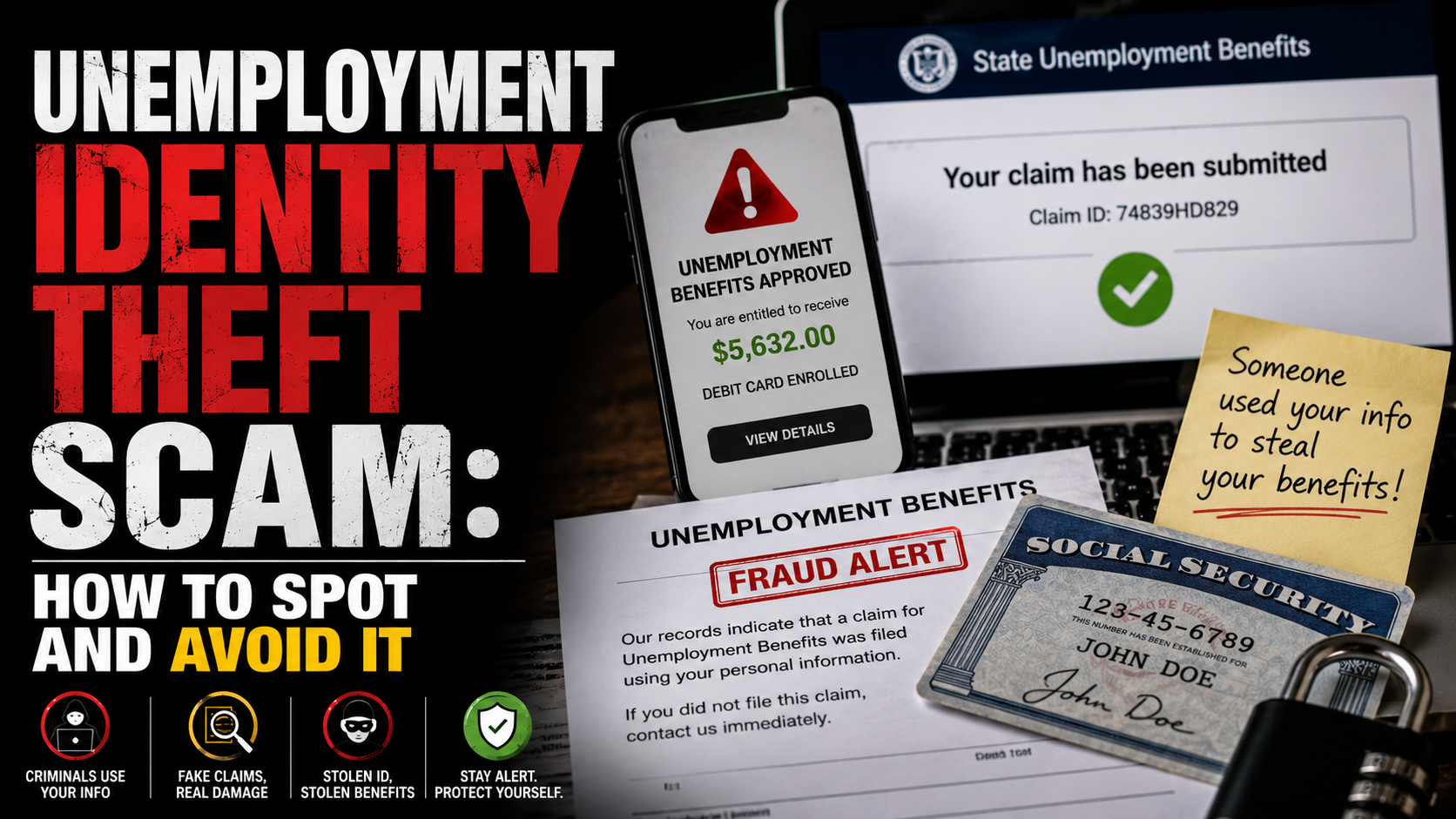
The tax refund text scam causes harm in two distinct ways. The first is the direct financial harm of card details entered on fraudulent sites being used for unauthorised purchases. The second — and often more serious — is the identity theft enabled by the personal information collected during the fake refund claim process, including Social Security or National Insurance numbers, date of birth, address, and banking details that enable much broader financial fraud beyond the immediate transaction. This is the same identity-theft mechanism behind the unemployment identity theft scam.
How It Works, Step by Step
Every tax refund text scam follows the same six-stage pattern, from the first message to the eventual financial damage.
Step 1: The Fake Tax Refund Message Arrives
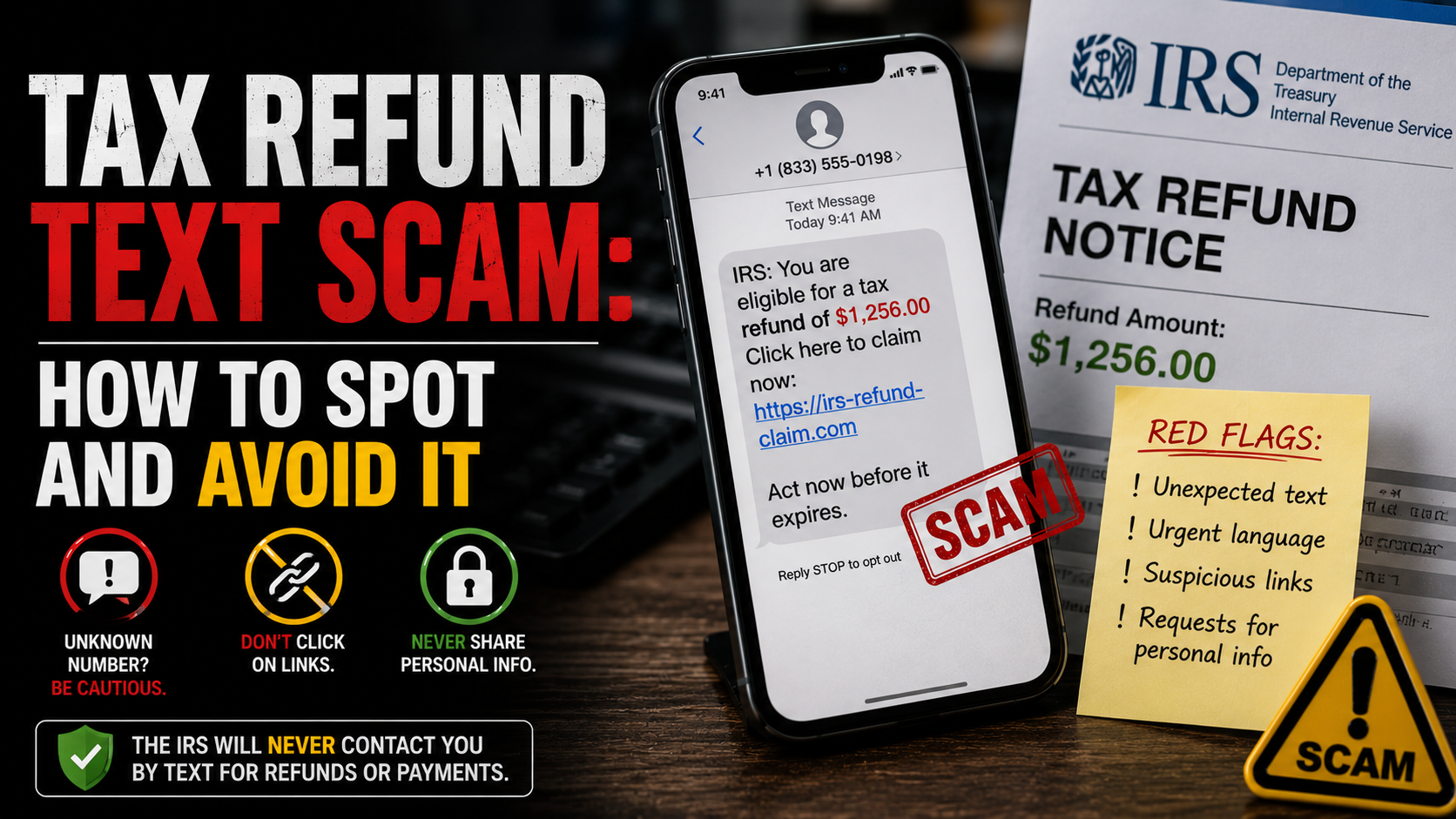
The tax refund text scam begins with an unsolicited text message or email appearing to come from a tax authority. It states that you are entitled to a refund of a specific amount — often a realistic figure such as $312, $847, or £294 — and that the refund is available to claim immediately through a provided link. The message creates urgency by stating the refund will expire if not claimed within a short window, typically 24 to 72 hours. It may include your name, sourced from data breaches, to feel personalised, and the sender ID may be spoofed to show “IRS” or “HMRC”.
Step 2: The Urgency and Expiry Warning
You are told your refund will be cancelled, returned to the treasury, or forfeited unless claimed within the stated window. For someone who has been waiting for a legitimate refund, the threat of losing money they are owed is particularly motivating. This urgency is deliberately calibrated to prevent you from pausing to verify the message independently — the same pressure tactic used in the traffic violation text scam.
Step 3: The Fake Tax Portal
Clicking the link in a tax refund text scam message leads to a website that closely mimics the genuine tax authority’s online portal — official logo, colour scheme, and layout. The URL is designed to look plausible, combining the agency’s name with words like “refund”, “claim”, or “portal” in a non-.gov domain. On mobile devices, where the full URL is not visible and the screen is smaller, the fake site is particularly hard to distinguish from the real one.
Step 4: Harvesting Personal and Financial Information
The fake portal presents a multi-step refund claim form that asks for progressively more sensitive information — starting with name and address, then Social Security or National Insurance number, date of birth, and employment details, before requesting bank account or payment card information to “process the refund deposit”. Each piece of information is captured immediately by the criminals running the tax refund text scam.
Step 5: The Confirmation and False Reassurance
After submitting their information, the victim receives a professional-looking confirmation page stating the refund application has been received and will be processed within three to five business days. This reduces immediate suspicion — the victim expects to wait, and will not become alarmed until a week or more has passed.
Step 6: The Consequences Emerge
The impact of the tax refund text scam typically becomes apparent through unauthorised card charges, fraudulent accounts opened in the victim’s name, a genuine communication from the actual tax authority showing no such refund exists, or a credit monitoring alert. By this point the harvested information has been in criminal hands for days or weeks.
Tax Refund Text Scam Variants
6 VariantsThe tax refund text scam is not a single fraud but a family of closely related variants. These are the six most common.
The IRS Refund Text Scam
Most prevalent US tax refund text scam variantThe HMRC Refund Text Scam
Most prevalent UK tax refund text scam variantThe State Tax Refund Scam
Targets state-level taxpayersThe COVID Relief Refund Scam
Exploits pandemic-era contextThe Email Phishing Variant
The tax refund text scam delivered by emailThe Spoofed Sender ID Variant
Appears in your real agency message threadTax Refund Text Scam Warning Signs
🚩 Tax Refund Text Scam Red Flags
- You received an unsolicited text or email about a tax refund. The IRS does not initiate refund contact by text or email; HMRC does not send texts with links to claim refunds. Any unsolicited refund message is almost certainly a tax refund text scam.
- The message contains a link to claim the refund. Genuine tax agencies direct you to log in to your account by typing the URL yourself — never via a link in a message.
- The refund will “expire” if not claimed immediately. Real tax refunds do not expire within 24 to 72 hours of a text. Expiry threats are a standard tax refund text scam urgency tactic.
- The link does not go to a .gov domain. In the US the IRS site is irs.gov; in the UK, HMRC’s portal is part of gov.uk. Any other domain is a phishing site, no matter how official it looks.
- You are asked for card details to receive the refund. Tax authorities deposit refunds to a registered bank account or mail a cheque — they never ask for card details to send you money.
- The message uses a generic greeting. “Dear taxpayer” or “Dear customer” rather than your actual name is a strong indicator of a tax refund text scam.
- The refund is a specific, realistic figure. A precise amount like $847 or £312 is a fabrication designed to make the scam feel credible and suppress your scepticism.
Real Stories
The Accountant Who Fell for the HMRC Text
A forty-six-year-old accountant — someone with professional knowledge of tax systems — received a text in early February claiming to be from HMRC and stating she was owed an £847.50 self-assessment refund. The amount closely matched a refund she was genuinely expecting from a return she had submitted the previous month. The coincidence of amount and timing made the tax refund text scam feel entirely legitimate. She clicked the link, completed the claim form, and entered her National Insurance number, date of birth, and bank details. Three days later a genuine HMRC letter about her actual refund arrived — the scam had harvested her details in the interval. A £340 fraudulent direct debit had been set up on her account; her bank reversed it, but she had to close and replace the account.
The Student and the IRS Refund Email
A twenty-three-year-old university student received an email claiming to be from the IRS stating that a $612 refund was available. As a first-time filer unsure of what to expect, he completed the form on the fake site, providing his Social Security number, date of birth, and a prepaid debit card number. No refund arrived. Two months later he discovered his Social Security number had been used to file a fraudulent tax return in another state — a tax identity theft situation, triggered by a single tax refund text scam email, that took over eight months to fully resolve.
The Retiree and the COVID Relief Text
A sixty-five-year-old retiree received a text claiming unclaimed COVID-19 tax relief was being distributed and that she was eligible for a $1,400 payment expiring within 48 hours. Having received a genuine stimulus payment in a previous year, the context felt familiar. She completed the claim form with her Social Security number, date of birth, address, and bank details. When she mentioned it to her daughter two days later, her daughter immediately recognised the tax refund text scam. A fraudulent $890 direct debit attempt had already been blocked by her bank — but her Social Security number was compromised, requiring fraud alerts, a credit freeze, and ongoing monitoring.
What Tax Authorities Say
Tax authorities in every major jurisdiction have published specific and repeated warnings about the tax refund text scam, all delivering the same message: genuine tax agencies do not initiate contact by text message or email about refunds.
The Internal Revenue Service has been explicit for years that it does not send unsolicited texts or emails about refunds — all refund-related contact is initiated by post. The IRS warns that any text or email claiming to be from the IRS about a refund is a phishing attempt and should be reported to phishing@irs.gov. Its guidance is at irs.gov/identity-theft-central.
The Federal Trade Commission addressed the tax refund text scam directly in a January 2026 consumer alert, advising people to go straight to irs.gov or their state tax agency’s website to check refund status rather than clicking any link. Report at reportfraud.ftc.gov.
HMRC in the UK confirms it never sends text messages with links to claim refunds and never asks for personal or financial information by text. Suspicious texts can be forwarded to 7726 and emails to phishing@hmrc.gov.uk. General fraud reports go to Action Fraud at actionfraud.police.uk.
How to Protect Yourself
Never Click Links in Tax Refund Texts or Emails
The single most effective protection against the tax refund text scam is never clicking a link in any message claiming to be from a tax authority about a refund. This rule defeats every variant completely. To check a genuine refund, type the official URL into your browser yourself — irs.gov in the US, gov.uk in the UK — and log in there.
Know How Tax Authorities Actually Communicate
Protecting yourself from the tax refund text scam is far easier once you know how genuine agencies operate. The IRS communicates primarily by post; HMRC communicates by post and through the Government Gateway online account. When you know the genuine agency’s standard practice, any channel that differs from it is immediately suspicious. The same principle applies across every impersonation fraud — see our guide to imposter scam warning signs.
Report Suspicious Messages Immediately
Forward suspicious messages to the relevant authority before deleting them. In the US, forward IRS phishing texts to 202-552-1226 and emails to phishing@irs.gov. In the UK, forward texts to 7726 and emails to phishing@hmrc.gov.uk.
Check Your Refund Status Through Official Channels Only
If you are genuinely expecting a refund, use the official tools — the IRS “Where’s My Refund?” tool at irs.gov, or your Government Gateway account at gov.uk. These give accurate status information with zero phishing exposure and put the tax refund text scam completely out of reach.
Place a Tax Identity Protection PIN With the IRS
US taxpayers can enrol in the IRS Identity Protection PIN programme — a six-digit number that must be on your tax return to verify your identity, making it much harder for criminals to file a fraudulent return in your name. Enrol at irs.gov/identity-theft-central.
What to Do If You Have Been Targeted
If you have already responded to a tax refund text scam, act quickly — the steps below limit the damage.
Contact your bank immediately
If you entered card or bank details, call your bank or card provider now. Report that your details were compromised through a fraudulent government website, request card cancellation and replacement, and ask them to check for any unauthorised direct debit set up without your authorisation. Acting within hours of a tax refund text scam materially limits the loss.
Report to the IRS and FTC (US)
If you submitted personal information — particularly your Social Security number — report the identity theft at irs.gov/identity-theft-central and file an Identity Theft Affidavit if appropriate. Report the phishing attempt to phishing@irs.gov and file with the FTC at reportfraud.ftc.gov, then use the recovery plan at identitytheft.gov.
Report to HMRC and Action Fraud (UK)
Report to HMRC at phishing@hmrc.gov.uk, to Action Fraud at actionfraud.police.uk, and to the NCSC at report.ncsc.gov.uk. If your National Insurance number was compromised, contact HMRC’s dedicated helpline and consider a fraud alert on your credit file.
Place a fraud alert and credit freeze
If identity information was submitted, place a fraud alert and credit freeze with all major credit bureaus immediately — Equifax, Experian and TransUnion in the US. Monitor your credit report for any new accounts or enquiries you did not authorise.
File your tax return early next season
If your Social Security or National Insurance number was submitted, file your next tax return as early as possible. Filing early reduces the window for a criminal to file a fraudulent return in your name before you do — one of the most common downstream consequences of the tax refund text scam.
Where to Report It
Reporting the tax refund text scam helps authorities track fraudsters and take down fake tax refund websites. Use the body that matches your country and situation.
Frequently Asked Questions
Think You have Been Scammed?
Act fast — contact your bank, then report it through the official channels.