Government Grant Scam: How to Spot and Avoid It
A call, text, or Facebook message says you have been selected for free government money. The government grant scam weaponises official authority and financial hope — here is how it works and how to shut it down.
⚡ Quick Summary — Government Grant Scam
- What it is: the government grant scam impersonates government agencies to convince you that you have been selected for a free grant, then extracts fees and personal information
- Who it targets: consumers of all ages and incomes — especially seniors, small business owners, students, and anyone in financial difficulty
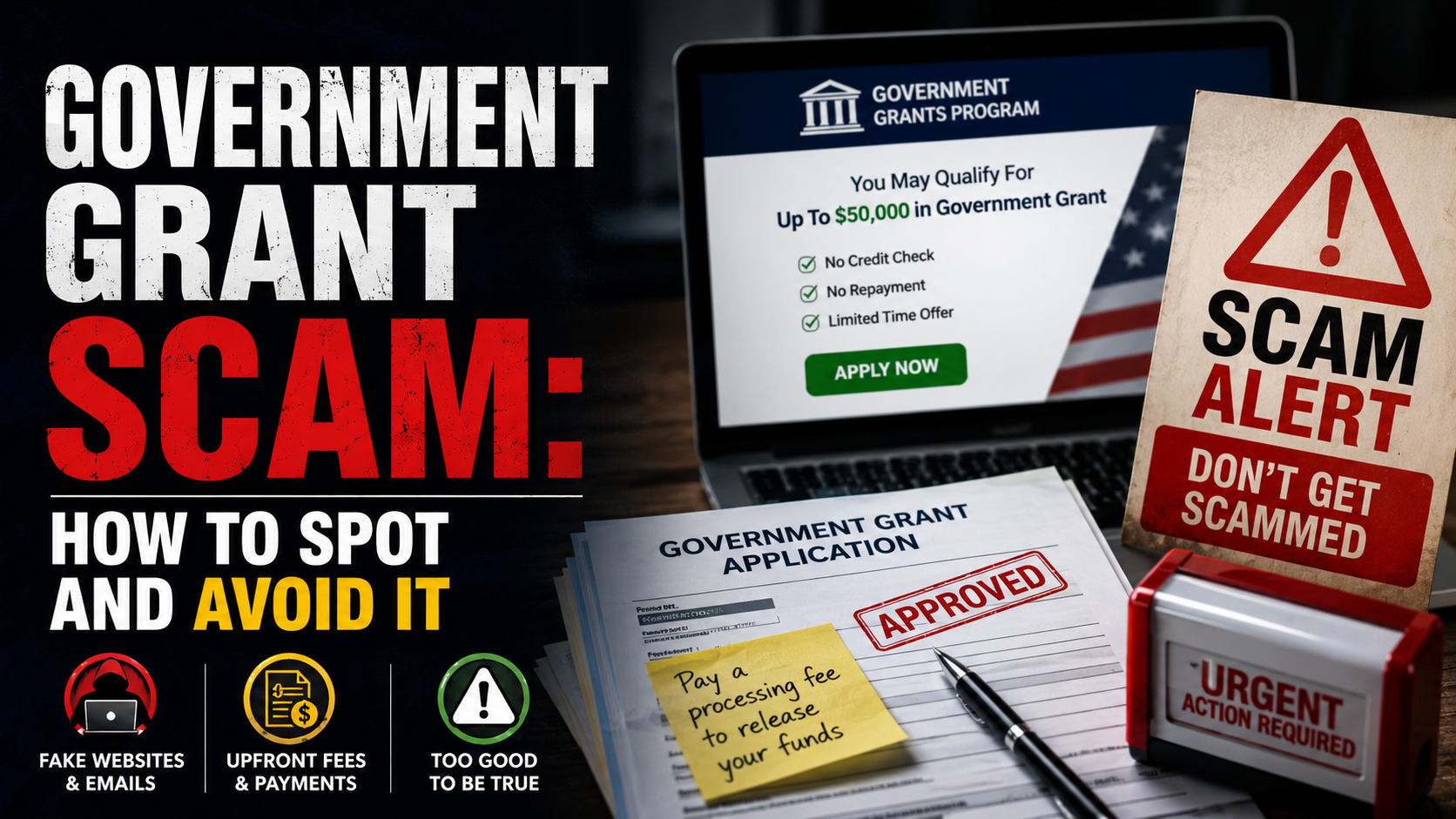
- The core red flag: you did not apply for the grant, and you are asked to pay a fee to receive it
- How they take your money: “processing fees” demanded in gift cards, wire transfer, or crypto — plus personal data harvested for identity theft
- The golden rule: the government never contacts you about a grant you did not apply for, and no real grant requires an upfront fee
⚠️ Already Paid a “Processing Fee”?
If you have paid a fee or shared personal information with a government grant scam, contact your bank or card provider immediately and place a credit freeze. Then jump to the What to Do If You Have Been Targeted section below for the full step-by-step recovery process.
📋 Table of Contents
- What Is the Government Grant Scam?
- How the Government Grant Scam Works, Step by Step
- Government Grant Scam Variants
- Government Grant Scam Warning Signs
- Real Stories: How It Affects Real People
- What Authorities Say
- How to Protect Yourself
- What to Do If You Have Been Targeted
- Where to Report It
- Frequently Asked Questions
- Related Scam Guides
What Is the Government Grant Scam
The government grant scam is a fraud in which criminals impersonate government agencies, officials, or grant programmes to convince consumers that they have been selected to receive a free government grant — and then extract personal information, processing fees, or banking details under the pretence of facilitating the delivery of that grant. The grant money never exists. No government agency is involved. The only real transaction in the government grant scam is the fee paid by the victim or the personal information surrendered during the supposed application process.
The government grant scam is part of the broader prize and grant scam category, which the FTC consistently identifies as one of the most reported fraud types by volume of consumer complaints. It operates across multiple channels — phone calls, text messages, social media messages, email, and increasingly through social media advertisements featuring what appears to be genuine government branding — and targets consumers of all ages, income levels, and educational backgrounds.
An important distinction to understand is that genuine government grants do exist — for businesses, researchers, nonprofit organisations, students, and in some cases individuals. The difference is that genuine government grants require a formal application process, are widely publicly advertised, never require upfront payment to receive, and are never awarded to random individuals who have not applied. Any grant that arrives as an unexpected notification claiming you have been specifically selected is a government grant scam.
How It Works, Step by Step
Almost every version of the government grant scam follows the same six-stage pattern, from the first unsolicited notification to the moment the grant fails to arrive.
Step 1: The Unexpected Notification
The government grant scam begins with an unsolicited contact claiming the recipient has been selected to receive a government grant. This arrives through multiple possible channels — a phone call from someone claiming to be a government grant officer, a text claiming approval for a specific grant programme, a Facebook message or comment claiming an agency is distributing grants to citizens who meet certain criteria, an email with official-looking government branding, or a social media advertisement promoting a grant registration portal. The notification is carefully designed to feel legitimate: it references real agencies — the Department of Housing, the Small Business Administration, the Department of Energy — uses official-sounding language, may include a government seal, and cites a specific amount, typically between $2,500 and $25,000, realistic enough to seem plausible.
Step 2: Creating Excitement and Urgency
After establishing that the recipient has been awarded a grant, the government grant scam creates both excitement — you have been specifically chosen for free money — and urgency — you must claim it within a specific timeframe or forfeit it. The combination of exciting financial news and a deadline is calibrated to prevent the recipient from pausing to independently verify the grant’s existence. Some variants add an element of exclusivity — you were selected from a limited pool, or the grant is part of a programme that is not widely publicised — which further suppresses the instinct to search for independent information.
Step 3: The Application or Verification Process
To claim the grant, the government grant scam instructs the victim to complete a verification or application process designed to harvest data. This is designed to collect personal information — name, address, date of birth, Social Security or National Insurance number, bank account details — under the guise of identity verification required to process the grant payment. The information collected is used for identity theft, targeted phishing, or sale to criminal data networks, regardless of whether a processing fee is also extracted.
Step 4: The Processing Fee
The financial extraction mechanism is the processing fee — described as a government tax, an administrative charge, a release fee, an insurance payment, or a processing cost required to facilitate the grant disbursement. It is framed as a standard requirement to pay before the grant money can be released. Common amounts range from $100 to $500 — small enough relative to the promised grant that paying it appears rational. The fee is typically demanded through untraceable payment methods — gift cards, wire transfers, or cryptocurrency — specifically to prevent recovery. Some variants collect the fee by requesting debit card details directly, enabling recurring unauthorised charges.
Step 5: Escalating Fees
After the initial processing fee is paid, the government grant scam frequently demands additional payments — a federal tax charge, a legal compliance fee, a bank release fee, or an insurance deposit. Each new fee is explained as an unavoidable regulatory requirement that must be resolved before the grant can be disbursed. Victims who have already paid one fee feel significant pressure to pay more to protect their initial payment — a classic sunk cost trap the scam exploits deliberately.
Step 6: The Grant Never Arrives
After all fees have been paid and all personal information collected, the government grant scam collapses. The grant money never arrives. The contact becomes unreachable. The website or profile used by the scammer disappears. The victim is left with financial losses from the fees paid, potential identity theft from the information surrendered, and the realisation that no genuine grant was ever involved. Recovery of fees paid — particularly through gift cards or wire transfers — is typically impossible.
Government Grant Scam Variants
5 VariantsThe government grant scam is not a single fraud but a family of related variants — each government grant scam variant works a little differently. These are the five most common.
The Facebook Grant Scam
A government grant scam on FacebookThe Phone Call Grant Scam
A fake government grant officerThe Housing and Energy Grant Scam
A government grant scam on homeownersThe Small Business Grant Scam
Fake recovery and innovation fundingThe Student Grant Scam
Fake education funding and loan forgivenessGovernment Grant Scam Warning Signs
🚩 Government Grant Scam Red Flags
- You did not apply for the grant. This is the most fundamental warning sign. Genuine government grants require a formal application — you cannot be awarded a grant you did not apply for. Any notification claiming you have been selected without having applied is a government grant scam.
- You must pay a fee to receive the grant. No legitimate government grant requires the recipient to pay any fee — processing, administrative, tax, insurance, or otherwise — before the funds are disbursed. Any request for upfront payment to release a grant is a definitive government grant scam red flag.
- The contact was unsolicited. Genuine grant notifications follow a formal application and review process — they are expected communications, not surprises. An unsolicited call, message, or email claiming you have been awarded a grant is the primary indicator of the government grant scam.
- Payment is requested in gift cards, wire transfer, or cryptocurrency. Government agencies collect fees through official payment portals, cheques, or bank transfers to verified government accounts — never through gift cards, wire transfers to private accounts, or cryptocurrency. Any such request is a definitive government grant scam.
- The programme cannot be independently verified. Every genuine government grant programme is publicly documented on official government websites. If you cannot find the programme by searching the relevant agency’s official site, it does not exist.
- The caller asks for your Social Security or bank account number. Genuine grant officers do not collect sensitive personal or financial information through unsolicited phone calls. Any such request during an unexpected call is a government grant scam data-harvesting tactic.
- Urgency — you must claim the grant today. Government grant programmes have defined processes with published timelines — they do not expire within hours of a phone call. Extreme time pressure is a standard government grant scam tactic to prevent independent verification.
- The grant is described as secret or not publicly known. There are no secret government grant programmes — all government spending is publicly accountable. Any claim that a programme is not publicly advertised is a fabrication used to stop you searching for independent information.
Real Stories
The Grandmother and the Facebook Grant
The government grant scam often arrives through a trusted face. A seventy-three-year-old grandmother received a Facebook message from what appeared to be her granddaughter’s account, telling her that a government grant programme was distributing $8,500 to eligible seniors and that she should contact a specific Facebook profile to claim hers. The granddaughter’s account had been compromised and used without her knowledge. The grandmother messaged the fake grant officer and was told she qualified for the full $8,500 but needed to pay a $250 processing fee using Google Play gift cards. She purchased the cards and shared the codes. She was then told a $350 federal tax payment was required, and she paid that too. When a third fee was demanded, she called her granddaughter directly — and discovered the account had been hacked. The government grant scam had cost her $600 in gift card purchases. The promised $8,500 grant did not exist.
The Small Business Owner and the Recovery Grant
A small restaurant owner received an email claiming a government small business recovery programme had identified his business as eligible for a $15,000 grant based on his tax filing history. The email used official-looking government branding and cited a real agency, and directed him to a professional-looking website to complete his grant application. During the process, the government grant scam website collected his business registration number, Social Security number, and bank account details for “direct deposit of the grant funds.” He also paid a $399 application processing fee by credit card. No grant was ever disbursed. His bank account details were used to attempt an unauthorised withdrawal that his bank flagged and blocked. He recovered the $399 through a chargeback, but his personal and business information had been compromised, and the subsequent identity protection measures cost him over 40 hours of administrative effort.
The Single Mother and the Housing Grant
A single mother renting a flat received a call from someone claiming to be from a government energy efficiency scheme, saying she had been selected for free insulation and boiler replacement worth £7,500 under a government environmental programme. A home assessment was booked, and the assessor visited, confirmed her eligibility, and asked for a £150 “materials deposit” that would be refunded when the installation was complete. She paid the £150. No installation was ever scheduled, and the assessor’s phone number was disconnected within a week. When she researched the scheme, she found references to the genuine government programme it was impersonating — but the company that contacted her was not a registered installer and the scheme name had been fabricated. The government grant scam had cost her £150 and the expectation of home improvements that never materialised.
What Authorities Say
The government grant scam has been specifically addressed by the FTC, the CFPB, and consumer protection bodies in both the US and UK — all delivering the same core message about the government grant scam.
The Federal Trade Commission addressed the government grant scam in a March 2026 consumer alert, listing common warning signs and reiterating its core guidance: the government does not call, text, email, or message people on social media to tell them they have won a grant. If someone contacts you out of the blue claiming you have been selected for a grant, it is a scam. The FTC further notes that the scam frequently uses the names of real agencies to appear legitimate — but the use of a real agency name does not mean the contact is from that agency. Review FTC guidance at consumer.ftc.gov/scams and report fraud at reportfraud.ftc.gov.
Action Fraud in the UK has documented the government grant scam operating in its UK variants — impersonating HMRC, the Department for Work and Pensions, local councils, and government energy efficiency schemes. Report UK variants at actionfraud.police.uk or call 0300 123 2040.
The Consumer Financial Protection Bureau has taken enforcement action against companies running government grant scam operations — particularly those targeting financially vulnerable consumers — and accepts complaints at consumerfinance.gov/complaint.
The Better Business Bureau documents thousands of government grant scam complaints annually and publishes active scam alerts about specific campaigns, at bbb.org/scamtracker.
How to Protect Yourself
Remember: The Government Does Not Contact You About Grants
This is the single most important rule for protecting yourself from the government grant scam. Government agencies do not call, text, email, or message people on social media to inform them they have been selected for a grant they did not apply for. Genuine government grants require a formal application process. If you receive any unsolicited contact claiming you have been selected for a government grant, it is the government grant scam regardless of how official it looks or sounds.
Never Pay Fees to Receive a Government Grant
No legitimate government grant requires the recipient to pay any fee before receiving the funds. Processing fees, administrative charges, tax payments, insurance deposits, and release fees are all hallmarks of the government grant scam. If any contact claiming to represent a grant programme asks for payment — in any form, for any reason — end the interaction immediately and report it. This is the same upfront-fee pattern seen across many imposter scams.
Verify Through Official Government Websites Only
If you receive a grant notification and want to verify whether it is genuine, search for the programme name on the official government website — in the US this means .gov domains such as usa.gov or grants.gov; in the UK this means .gov.uk domains. If the programme cannot be found on an official government website, it does not exist. Never verify through a link in the message received — this may lead to a fake verification portal designed to collect your information.
Report Suspicious Facebook Grant Messages
If you receive a Facebook message or see a comment about a government grant — particularly one that appears to come from a friend or family member’s account — contact that person directly through another channel to verify they sent it. If their account has been compromised, alert them immediately so they can secure it. Report the fraudulent message and the impersonating account to Facebook using the in-app reporting tool. This helps Facebook identify and remove government grant scam operations faster.
Know Where to Find Genuine Government Grants
Genuine government grant information in the US is available through Grants.gov — the official federal grants portal at grants.gov — which lists all federally funded grant opportunities. In the UK, genuine information is available through the official GOV.UK website at gov.uk. If a grant is genuine, it will be findable through these official sources. If it cannot be found there, it is almost certainly a government grant scam.
What to Do If You Have Been Targeted
If you have already paid a fee or shared information with a government grant scam operator, act quickly to limit the damage the government grant scam can do. The steps below give you the best chance of limiting the damage.
Contact your bank or card provider immediately
If you paid a processing fee using a credit or debit card, contact your card provider immediately and initiate a chargeback — explain that you paid for a service, grant processing, that was never delivered. If you paid by debit card, your bank may also be able to open a dispute. If you paid by gift card or wire transfer, recovery is significantly harder, but still report it to your bank and the authorities as a fraud record.
Protect your personal information
If you shared personal information — Social Security number, National Insurance number, bank account details, or other sensitive data — take immediate steps to protect yourself from identity fraud. Place a fraud alert or credit freeze on your credit file through the major credit bureaus, monitor your bank accounts and credit report for unauthorised activity, and contact your bank to alert them to the potential exposure of your account details.
Report the gift card usage to the card issuer
If you were directed to buy gift cards and share the codes, contact the gift card issuer immediately — Google, Amazon, Apple, or whichever brand — and report that the cards were used in a scam. Provide the card numbers. If the codes have not yet been redeemed, the issuer may be able to freeze the balance. This step is time-critical — codes are typically redeemed within minutes.
Report to the FTC, CFPB, or Action Fraud
US victims should report to the FTC at reportfraud.ftc.gov and the CFPB at consumerfinance.gov/complaint. UK victims should report to Action Fraud at actionfraud.police.uk. Provide the contact method used, any website URLs, phone numbers, email addresses, the amount paid, and a description of what was promised and what was delivered.
Warn your community
The government grant scam spreads through social networks and word of mouth. Tell friends, family, and community groups what happened — particularly anyone who may be in financial difficulty and therefore more receptive to a false offer of free government money. Your account could stop someone else paying a fee for a grant that does not exist.
Where to Report It
Reporting the government grant scam helps authorities take enforcement action against the operators and warn other consumers. Use the body that matches your country and situation.
Frequently Asked Questions
Think You have Been Scammed?
Act fast — contact your bank, then report it through the official channels.