Ponzi Schemes: How to Avoid Becoming a Victim & Impacts
Ponzi schemes promise consistent, high returns funded entirely by new investors’ money rather than any real profit. They always collapse, and the vast majority of investors lose money. This guide covers exactly how Ponzi schemes work, the warning signs, and how to protect yourself.
⚡ Quick Summary — Ponzi Schemes
- What they are: Ponzi schemes are investment frauds that pay returns to earlier investors using the capital of newer investors, rather than from any legitimate profit-generating activity
- Why they matter: Ponzi schemes have caused some of the largest financial frauds in history, with total losses across major cases reaching tens of billions of dollars, and they always collapse eventually
- The biggest three signs: consistently high returns regardless of market conditions, vague or secretive investment strategies, and difficulty withdrawing funds
- How they reach you: personal and professional networks, investment clubs, social media, cryptocurrency platforms, and affinity groups (religious, ethnic, or community ties)
- The golden rule: if an investment promises consistent high returns with little or no risk, and you cannot verify exactly how those returns are generated, you are very likely looking at a Ponzi scheme
⚠️ Already Invested in a Suspected Ponzi Scheme?
Stop adding further funds immediately and attempt to withdraw what you can. Contact your bank or brokerage if payments were made by card or transfer. Then jump to the What to Do If You Have Been Targeted section below.
📋 Table of Contents
What Is a Ponzi Scheme
A Ponzi scheme is a fraudulent investment operation that pays returns to existing investors using funds contributed by newer investors, rather than from any legitimate profit. Named after Charles Ponzi, who ran a notorious scheme in 1920 promising 50% returns within 45 days through international postal reply coupons, Ponzi schemes have remained one of the most damaging and persistent forms of investment fraud for over a century.
Ponzi schemes work because the early “returns” are real — they create powerful social proof. Investors who receive their promised payments become enthusiastic, often unwittingly recruiting friends and family. This apparent legitimacy is what makes Ponzi schemes so dangerous: the fraud is, for a period, indistinguishable from genuine investment success.
Ponzi schemes are closely related to but structurally distinct from pyramid schemes. A pyramid scheme requires each participant to actively recruit new members to earn money; a Ponzi scheme typically involves a single operator or firm managing all investor funds centrally, with the investor unaware their “returns” come from other investors rather than genuine trading or business activity.
Ponzi schemes have produced some of the largest financial frauds in modern history. Several documented cases — involving fraudulent investment advisers, fake securities portfolios, and fabricated business operations — resulted in losses ranging from hundreds of millions to tens of billions of dollars, and led to some of the longest fraud-related prison sentences ever handed down in the United States.
How Ponzi Schemes Work, Step by Step
Most Ponzi schemes follow the same five-stage structure, regardless of the specific investment vehicle used as the cover story.
Stage 1: Recruitment of Initial Investors
The operator recruits a small number of initial investors, typically through personal connections, professional reputation, or community and religious networks — a tactic known as affinity fraud. Ponzi schemes frequently target close-knit communities where trust is already established, making scrutiny less likely.
Stage 2: Early Payouts
Initial investors receive the promised returns, often paid promptly and in full. These payments come entirely from the capital of new investors, not from any genuine profit-generating activity. This stage is what gives Ponzi schemes their persuasive power — the early payouts are real money in real accounts.
Stage 3: Rapid Expansion
Word spreads about the consistent, attractive returns. New investors are drawn in by the testimonials and apparent success of earlier participants. The scheme appears to be a genuinely profitable, possibly even exclusive, investment opportunity during this phase.
Stage 4: Peak and Strain
Eventually the scheme requires an increasingly large flow of new investment to meet its obligations to existing investors. Market downturns, economic uncertainty, or simple saturation of the operator’s network can slow new investment, putting the structure under strain.
Stage 5: Collapse
When new investment can no longer cover the promised payouts — or when a wave of investors attempt to withdraw simultaneously — the Ponzi scheme collapses. The operator may abscond with remaining funds, or the fraud may be exposed through regulatory investigation or investor complaints. The majority of investors, particularly those who joined later, lose most or all of their investment.
The 10 Ponzi Schemes Warning Signs
🚩 The 10 Warning Signs of Ponzi Schemes
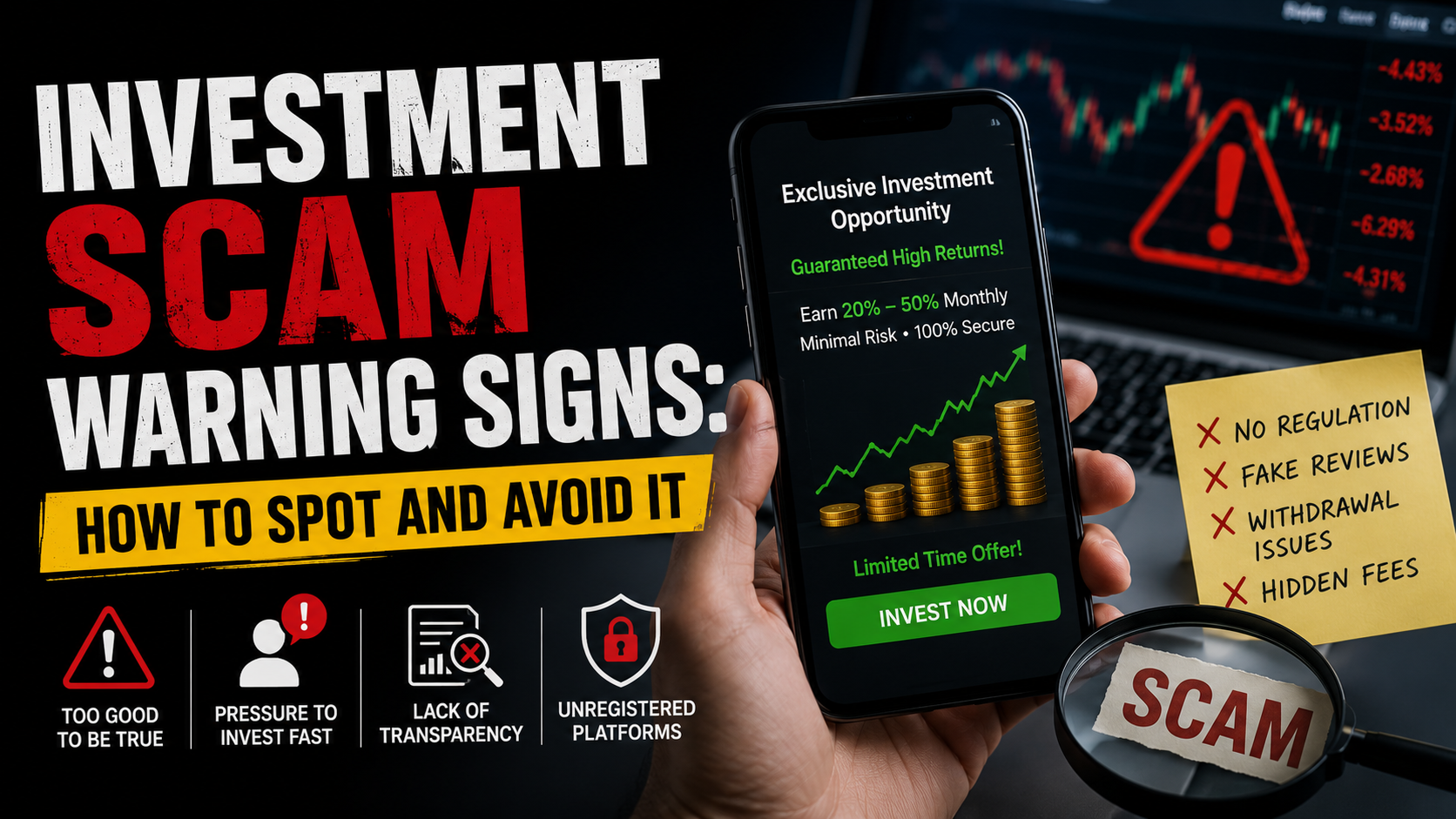
- 1. Consistently high returns regardless of market conditions. Genuine investments fluctuate with the market. A fund or adviser that reports steady, positive returns through every market condition — including downturns — is one of the clearest Ponzi schemes warning signs.
- 2. Returns that seem too good to be true. Promises of guaranteed double-digit monthly or annual returns with minimal risk are a hallmark of Ponzi schemes. No legitimate investment can reliably guarantee outsized returns.
- 3. A secretive or overly complex investment strategy. If the operator cannot or will not clearly explain how returns are generated, or describes the strategy as too sophisticated for investors to understand, this is a significant Ponzi schemes red flag.
- 4. The investment is unregistered. Verify any investment adviser or fund against the SEC’s IAPD database (US) or the FCA register (UK). Ponzi schemes are typically not registered with the relevant financial regulator, since registration would expose the fraudulent structure to scrutiny.
- 5. Difficulty obtaining clear paperwork or account statements. Vague, inconsistent, or hard-to-obtain documentation about your investment is common across Ponzi schemes, since genuine audited statements would reveal the absence of real underlying assets.
- 6. Delays or difficulty withdrawing funds. Early investors may withdraw freely. As a Ponzi scheme matures and the flow of new investment slows, withdrawal requests are met with excuses, delays, or partial payments — a critical warning sign that the structure is under strain.
- 7. Pressure to keep investing or reinvest your “returns.” Operators of Ponzi schemes often encourage investors to roll over their gains rather than withdraw them, since fresh withdrawals accelerate the depletion of available cash.
- 8. The opportunity is shared through close personal or community networks. Affinity fraud — exploiting trust within religious, ethnic, or social communities — is a recurring Ponzi schemes pattern. Be especially cautious of investment opportunities recommended primarily by people you know personally rather than through independent verification.
- 9. The operator has limited or unverifiable credentials. Check any adviser against FINRA BrokerCheck (US) or the FCA register (UK). An inability to verify credentials, or a history of regulatory action, is a serious Ponzi schemes red flag.
- 10. New investors are required to keep the scheme funded. If the fund or platform appears to depend on a constant stream of new deposits to remain “liquid,” rather than on genuine trading or business profit, this is the structural signature of a Ponzi scheme.
Ponzi Schemes Variants
5 VariantsPonzi schemes appear across many investment categories. Each variant uses a different cover story for the same underlying fraud — paying earlier investors with newer investors’ money.
Securities and Fund Ponzi Schemes
The fabricated-portfolio variantReal Estate Ponzi Schemes
The property-development variantForex and Commodities Ponzi Schemes
The trading-platform variantCryptocurrency Ponzi Schemes
The digital-asset variantHigh-Yield Investment Programs (HYIPs)
The online daily-return variantReal Stories: When the Signs Were Missed
The Retired Couple and the “Steady Returns” Fund Manager
A retired couple in their late sixties were introduced to a local fund manager through their church community. The manager reported consistent 8-10% annual returns regardless of market conditions over several years, with quarterly statements showing steady growth. They invested their retirement savings, encouraged by friends within the same congregation who had been “investing” with him for years and reported similarly strong returns.
When the couple requested a full withdrawal to fund a house purchase for their daughter, the manager offered a series of delays — paperwork issues, a temporary “lock-in period” they did not recall agreeing to, then a partial payment with promises of the remainder “next quarter.” Concerned, they contacted their state securities regulator, who confirmed the manager was not registered to manage investment funds. The fund collapsed within months, and dozens of investors within the same community network lost their combined retirement savings.
The lesson: consistently positive returns through every market condition, combined with an investment recommended through a trusted community network, are two of the clearest Ponzi schemes warning signs. Affinity fraud specifically exploits the reduced scrutiny that comes with trusted social connections.
The Small Business Owner and the Cryptocurrency “Trading Bot”
A small business owner was introduced to an online platform through a LinkedIn connection, promising a proprietary “trading bot” that generated 5% weekly returns on cryptocurrency deposits. The platform’s dashboard showed consistent gains, and early small withdrawals processed without issue, building confidence.
He invested $30,000 of his business’s working capital. For two months, the dashboard continued to show strong gains. When he attempted to withdraw the full balance to cover a tax payment, the platform required a “liquidity verification fee” before releasing funds. He paid it. A further “blockchain network fee” was then demanded. He refused to pay further and the platform stopped responding entirely days later.
The lesson: a “trading bot” or platform promising consistent weekly or daily returns with no transparent strategy is a recognisable Ponzi schemes pattern, particularly in the cryptocurrency space where genuine returns are inherently volatile, not steady.
The Professional Network and the “Exclusive” Real Estate Fund
A group of professionals within the same industry association were invited to invest in an “exclusive” real estate development fund managed by a well-regarded member of their network. The fund promised 12% annual returns from a series of supposed property developments, with glossy presentations and apparent site photographs.
Several members invested substantial sums, reassured by the involvement of others they trusted professionally. When one investor requested documentation of the specific properties involved, the request was met with vague explanations about “portfolio diversification” preventing disclosure of individual assets. The fund collapsed eighteen months later when a routine state audit revealed no actual property holdings existed.
The lesson: an inability to obtain clear, specific documentation about the underlying assets — even when the opportunity comes through a trusted professional network — is one of the most reliable Ponzi schemes warning signs. Trust in the recommender is not a substitute for independent verification of the investment itself.
What Authorities Say
Financial regulators treat Ponzi schemes as a well-understood and consistently enforced category of securities fraud, with extensive public guidance on the warning signs.
The Securities and Exchange Commission (SEC) in the US actively investigates and prosecutes Ponzi schemes, and maintains the largest enforcement record against this fraud type of any global regulator. Several of the largest fraud cases in US history — including investment advisory frauds resulting in tens of billions of dollars in losses and sentences of over a century in prison for the operators — were prosecuted as Ponzi schemes. The SEC’s core guidance: verify any investment adviser through its IAPD database before investing, and treat unusually consistent returns as a red flag rather than reassurance. Report at sec.gov/tcr.
The Financial Industry Regulatory Authority (FINRA) provides BrokerCheck, a free public tool for verifying any broker or investment adviser’s registration and disciplinary history before investing. Check at brokercheck.finra.org.
The Financial Conduct Authority (FCA) in the UK maintains a register of authorised firms and individuals, and operates the ScamSmart tool specifically to help consumers identify suspected investment fraud, including Ponzi-style schemes. Check at fca.org.uk/scamsmart.
The North American Securities Administrators Association (NASAA) coordinates state-level securities regulators across the US and publishes regular investor alerts about emerging Ponzi schemes patterns, including affinity fraud and cryptocurrency-related variants.
How to Protect Yourself
Verify Every Adviser and Fund Independently
Before investing anything, check the adviser or fund against FINRA BrokerCheck or the SEC’s IAPD database (US), or the FCA register (UK). This single step, taking only a few minutes, exposes the overwhelming majority of Ponzi schemes before any money changes hands.
Be Sceptical of Consistently Positive Returns
Genuine investments fluctuate. A fund reporting steady gains through every market condition — including periods when comparable legitimate investments lost value — is one of the most reliable Ponzi schemes indicators available to an ordinary investor.
Request and Scrutinise Independent Documentation
Ask for audited financial statements from a recognised independent auditor, not documents produced solely by the fund or adviser itself. Ponzi schemes frequently use unaudited, self-produced statements precisely because independent audit would expose the absence of real underlying assets.
Be Especially Cautious Within Trusted Networks
Affinity fraud — exploiting religious, ethnic, professional, or community trust — is a recurring pattern across Ponzi schemes. An investment being recommended by someone you trust personally does not substitute for independent verification of the investment itself.
Test Withdrawal Before Committing Further Funds
If you are already invested and have any doubts, request a partial withdrawal as a test. Delays, excuses, or partial payments in response to a withdrawal request are a critical warning sign that the structure may be under strain.
Diversify and Avoid Concentration
Never place a large proportion of your savings into a single fund, adviser, or platform, however trusted. Diversification limits the damage if any single investment — whether through fraud or genuine market failure — turns out badly.
What to Do If You Have Been Targeted
If you suspect you are invested in a Ponzi scheme, act quickly. The steps below give you the strongest chance of limiting further loss and supporting any recovery effort.
Attempt to withdraw funds and stop further investment
Request a full or partial withdrawal immediately and do not add any further money, regardless of reassurances offered. Document the response, including any delays, excuses, or partial payments.
Contact your bank or brokerage about payments made
If you funded the investment by card or bank transfer, contact your bank to ask about a chargeback or recall, particularly for recent payments. Recovery is more limited for older transfers but still worth reporting.
Report to the SEC, FCA, or your national securities regulator
US investors should report to the SEC at sec.gov/tcr and the FTC at reportfraud.ftc.gov. UK investors should report to the FCA and Action Fraud at actionfraud.police.uk.
Preserve all documentation
Keep every account statement, communication, promotional material, and payment record related to the investment. This documentation is essential for regulatory complaints, criminal investigations, and any civil recovery action that follows.
Watch for follow-up recovery scams
Victims of collapsed Ponzi schemes are frequently targeted by secondary “fund recovery” scams demanding an upfront fee to retrieve lost money. No legitimate recovery route — regulatory complaint, civil lawsuit, or bankruptcy claim — requires payment in advance.
Where to Report It
Reporting suspected Ponzi schemes helps regulators investigate and shut down fraudulent operations before more investors lose money. Use the channel relevant to your jurisdiction.
Frequently Asked Questions
Think You Have Invested in a Ponzi Scheme?
Attempt to withdraw, contact your bank, then report it through the official channels.