
Unemployment Identity Theft Scam: How to Spot and Avoid It
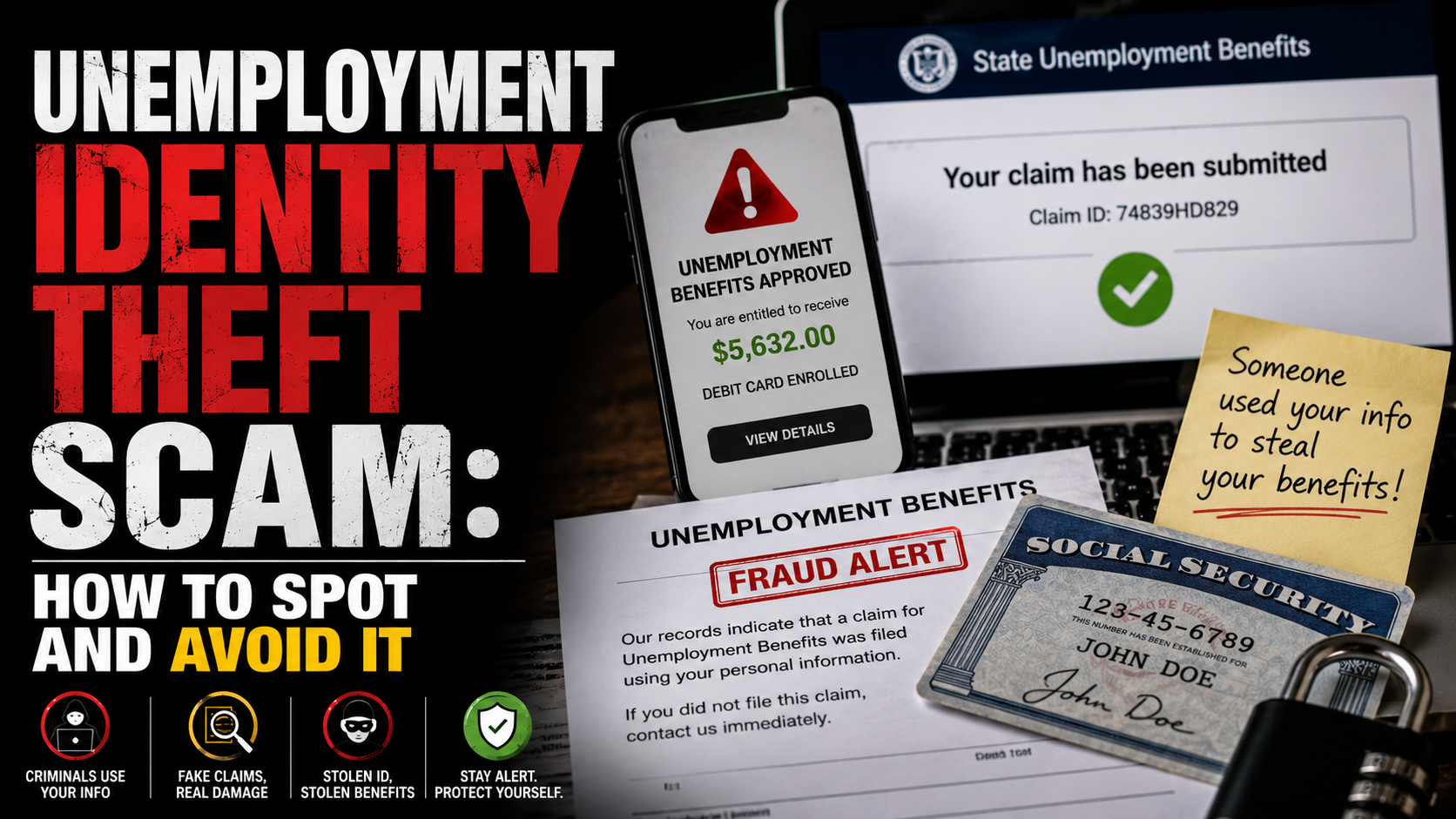
A letter arrives about unemployment benefits you never applied for. Criminals are using stolen personal information to file fraudulent claims in victims’ names — here is how it works and how to protect yourself.
⚡ Quick Summary — Unemployment Identity Theft Scam
- What it is: the unemployment identity theft scam uses stolen personal information to file fraudulent unemployment benefit claims in a victim’s name
- Who it targets: the unemployment identity theft scam can hit anyone whose Social Security number has been exposed — the employed, retired, self-employed, and between jobs alike
- The core problem: the unemployment identity theft scam requires no contact with the victim and no error on their part — it is committed entirely with breached data
- How it hurts you: unexpected tax bills, employment record complications, repayment demands, and months of admin to clear your name
- The golden rule: treat any letter about a claim you did not file as identity theft — report it immediately and freeze your credit
⚠️ Got a Letter About a Claim You Did Not File?
If you have received correspondence about an unemployment claim you never made, treat it as the unemployment identity theft scam and report it to your state unemployment agency immediately and place a credit freeze. Then jump to the What to Do If You Have Been Targeted section below for the full step-by-step recovery process.
📋 Table of Contents
- What Is the Unemployment Identity Theft Scam?
- How the Unemployment Identity Theft Scam Works, Step by Step
- Unemployment Identity Theft Scam Variants
- Unemployment Identity Theft Scam Warning Signs
- Real Stories: How It Affects Real People
- What Authorities Say
- How to Protect Yourself
- What to Do If You Have Been Targeted
- Where to Report It
- Frequently Asked Questions
- Related Scam Guides
What Is the Unemployment Identity Theft Scam
The unemployment identity theft scam is a form of government benefits fraud in which criminals use stolen personal information — typically a Social Security number combined with a name, date of birth, and address — to file fraudulent unemployment insurance claims with state or national employment agencies. The fraudulent claims are made in the victim’s name, the benefits are directed to bank accounts or debit cards controlled by the criminal, and the victim typically has no knowledge the fraud has occurred until they receive unexpected official correspondence about the claim.
The unemployment identity theft scam does not require the criminal to have any direct contact with the victim. Unlike phishing or social engineering frauds that manipulate victims into sharing their information, unemployment identity theft is committed entirely using information already in the criminal’s possession — obtained through data breaches, purchased from criminal data brokers, harvested from previous phishing campaigns, or sourced from the dark web. The victim plays no part in the fraud and may be entirely unaware of it until they discover its consequences.
This is what makes the unemployment identity theft scam simultaneously one of the most common and one of the most difficult forms of identity fraud for consumers to protect against. The underlying personal information — a Social Security number in particular — is widely available in criminal markets due to the scale of data breaches affecting every sector of the economy over the past decade. An estimated 40% of American adults have had their Social Security number exposed in a data breach, meaning an enormous proportion of the population is theoretically at risk of the unemployment identity theft scam at any time.
How It Works, Step by Step
Almost every version of the unemployment identity theft scam follows the same six-stage pattern, from the theft of personal data to the long tail of consequences for the victim.
Step 1: Obtaining the Victim’s Personal Information
The unemployment identity theft scam begins with the criminal obtaining a victim’s personal information. The most common sources include large-scale data breaches affecting healthcare providers, government agencies, financial institutions, and retailers; dark web markets selling stolen personal data in bulk; phishing campaigns that trick individuals into surrendering their details; and criminal data broker networks that compile and sell packages containing Social Security numbers, dates of birth, addresses, and employment history. The combination of data needed to file a fraudulent claim — name, SSN, date of birth, address, and basic information about the most recent employer — is commonly available in these markets.
Step 2: Filing the Fraudulent Claim
With the victim’s information in hand, the unemployment identity theft scam operator files an online unemployment insurance claim through the relevant state or national employment agency portal. The claim appears to come from the victim — the name, Social Security number, and employment details all match the victim’s genuine records — and the payment is directed to a bank account or prepaid debit card controlled by the criminal. The unemployment identity theft scam thrives here because many state systems have been modernised for online access, fraudulent claims can be filed, managed, and directed entirely digitally and anonymously.
Step 3: The Victim’s Employer Is Notified
State unemployment agencies typically notify an employer when a former — or, in the case of this scam, current — employee files a claim. An employer who receives a notification that a currently employed worker has filed for unemployment will usually alert that employee to the unemployment identity theft scam, who then discovers they are a victim for the first time. Not all victims are currently employed, however. The scam also targets people who are retired, self-employed, or between jobs, whose employers may not receive or act on a notification — leaving the fraud undiscovered for longer.
Step 4: The Victim Receives Official Correspondence
The most common way victims discover the unemployment identity theft scam is through unexpected official correspondence — a letter from the state unemployment agency about a claim they did not file, a notice about benefit payments deposited to an account they do not recognise, a tax form showing unemployment benefits they never received, or a demand for repayment of benefits paid on a fraudulent claim. Each of these discoveries initiates a reporting and remediation process that, while resolvable, requires significant time and administrative effort to undo the unemployment identity theft scam.
Step 5: The Tax Consequences
One of the most harmful consequences of the unemployment identity theft scam many victims do not anticipate is the tax dimension. Unemployment benefits are taxable income in the United States. When fraudulent benefits are paid in a victim’s name, the IRS may receive a 1099-G form reporting those benefits as income the victim received — resulting in an unexpected tax bill for money they never got. Resolving this requires filing an amended return, obtaining a corrected 1099-G from the relevant state agency, and potentially corresponding with the IRS to document the fraud — a process that can take months.
Step 6: Long-Term Credit and Identity Consequences
Beyond the immediate tax consequences, the unemployment identity theft scam may also affect the victim’s ability to file a genuine claim in the future — since the system may show a recent claim in their name — and may complicate employment background checks that reference government records. In the most serious cases, unresolved fraudulent claims may appear on credit files or generate debt collection activity if the agency seeks repayment from the victim rather than the criminal who actually received the money.
Unemployment Identity Theft Scam Variants
4 VariantsThe unemployment identity theft scam is not a single fraud but a family of related variants — each unemployment identity theft scam variant works a little differently. These are the four most common.
Standard Fraudulent Claim
The most common unemployment identity theft scam variantPhishing-Enabled Theft
An unemployment identity theft scam via phishingEmployer-Targeted Fraud
An unemployment identity theft scam at scaleSynthetic Identity Fraud
The hardest unemployment identity theft scam to catchUnemployment Identity Theft Scam Warning Signs
🚩 Unemployment Identity Theft Scam Red Flags
- You receive a letter about an unemployment claim you did not file. This is the clearest and most direct warning sign. Any official correspondence from a state unemployment agency or the Department of Work and Pensions about a claim you have no knowledge of should be treated as evidence of the unemployment identity theft scam and reported immediately.
- Your employer tells you a claim has been filed in your name. If your employer informs you they have received a notification of an unemployment claim while you are still employed, you have been targeted by the unemployment identity theft scam. Report it to your employer’s HR department and to the relevant state employment agency at once.
- You receive a 1099-G tax form for benefits you did not receive. A 1099-G reporting unemployment benefits you have no record of receiving is a strong indicator the fraud has been committed in your name. Report it to the issuing agency and to the IRS before filing your tax return.
- You receive a debit card or PIN for benefits you did not apply for. Some agencies mail prepaid benefit debit cards to claimants. Receiving such a card, or a PIN notification, for benefits you did not apply for is a direct unemployment identity theft scam red flag — do not activate or use the card, and report it immediately.
- You are denied benefits when you genuinely apply. If you legitimately lose your job and apply for unemployment but are told a claim was recently filed in your name, you have been targeted by the unemployment identity theft scam. This requires simultaneous reporting and establishing your genuine claim.
- Unexpected changes to your online unemployment account. If you have a genuine account and notice changes to your bank details, contact information, or payment direction that you did not make, your account may have been compromised as part of the unemployment identity theft scam. Secure it immediately and report the changes.
- Phishing messages claiming to be from unemployment agencies. Emails, texts, or calls asking you to verify your unemployment account, update payment information, or confirm your identity through an unsolicited link or number are phishing attacks tied to this fraud. Never click links or provide information in response.
Real Stories
The Teacher Who Discovered the Fraud at Tax Time
The unemployment identity theft scam often surfaces at tax time. A primary school teacher received a 1099-G form at the beginning of tax season reporting $14,200 in unemployment benefits received in her name during the previous year. She had been employed throughout the entire period and had never filed a claim — a textbook unemployment identity theft scam. A fraudulent claim had been filed using her Social Security number — sourced from a healthcare data breach she had been notified about two years earlier — and benefits had been directed to a prepaid debit card she never received. The IRS now had a record of $14,200 in income she had not declared. She spent fourteen hours over three weeks working with her state’s employment agency to obtain a corrected 1099-G, filing an amended tax return, documenting the fraud with the IRS, and placing a fraud alert on her credit file. No money had left her personal accounts, but the unemployment identity theft scam had cost her significant time, stress, and a filing fee.
The Professional Who Was Still Employed
A project manager received a call from his company’s HR director: the state employment agency had sent the company a notification that he had filed for unemployment. He was employed full-time with no intention of leaving. His HR director had immediately alerted him, recognising the unemployment identity theft scam pattern from previous cases. He reported the fraud and discovered a claim had been filed in his name two weeks earlier, with two benefit payments — $2,400 total — already made to a prepaid debit card. He filed fraud reports with the employment agency and the FTC and froze his credit. The fraudulent claim was terminated and no further payments were made, but the two already disbursed could not be recovered, and clearing his employment record required multiple hours of correspondence with the state agency.
The Retiree Who Faced a Repayment Demand
A seventy-one-year-old retiree received a letter from his state’s unemployment agency demanding repayment of $8,700 in benefits it claimed had been overpaid to him. He had retired three years earlier and had never filed for unemployment — he lived entirely on his pension and savings. The unemployment identity theft scam had run its course: a fraudulent claim filed in his name, benefits paid, and the agency, after identifying irregularities, had initially directed the repayment demand to the victim rather than the criminal. He spent over four months corresponding with the agency, filing official fraud reports, and ultimately engaging a nonprofit legal aid service to challenge the demand. The unemployment identity theft scam demand was eventually withdrawn and his record cleared — but the stress of being chased for money he never received was among the most challenging experiences of his retirement.
What Authorities Say
The unemployment identity theft scam has been specifically addressed by multiple government agencies and consumer protection bodies, all of which have published guidance on the unemployment identity theft scam and what to do if you discover you have been targeted.
The Federal Trade Commission published a specific consumer alert in February 2026, noting that receiving a letter about unemployment benefits you did not file is a sign of identity theft and explaining the steps consumers should take to report and resolve the fraud. The FTC maintains a dedicated identity theft resource at identitytheft.gov, which provides personalised recovery plans for identity theft victims. Report fraud to the FTC at reportfraud.ftc.gov.
The US Department of Labor has published specific guidance on unemployment insurance fraud reporting and maintains a fraud hotline for employers and employees to report suspected fraudulent claims. State workforce agencies, which administer unemployment insurance at the state level, each have dedicated fraud reporting mechanisms. The Department of Labor’s guidance is available at dol.gov.
The Internal Revenue Service provides specific guidance for victims who receive incorrect 1099-G forms, including instructions for obtaining corrected forms and handling the incorrect income reporting on tax returns. IRS guidance is available at irs.gov/identity-theft-central.
In the United Kingdom, the Department for Work and Pensions handles reports of fraudulent Universal Credit and benefits claims. Reports can be made to the National Benefits Fraud Hotline and through Action Fraud at actionfraud.police.uk.
How to Protect Yourself
Place a Credit Freeze on Your Credit File
A credit freeze — also called a security freeze — prevents new credit accounts from being opened in your name without your explicit authorisation. While a freeze does not directly stop the unemployment identity theft scam, it significantly limits the broader identity fraud criminals can commit with your personal information, including the synthetic identity variant. In the US, place a credit freeze with all three major credit bureaus — Equifax, Experian, and TransUnion — at no cost. The freeze can be temporarily lifted when you need to apply for credit.
Create an Online Account With Your State Unemployment Agency
Proactively creating an online account with your state’s unemployment insurance system — before you need to use it — is a simple block against the unemployment identity theft scam, preventing criminals from creating an account in your name first. If an account in your name already exists and you did not create it, that is itself a warning sign to report immediately. A genuine account also lets you monitor for fraudulent claim activity and receive notifications about claims filed in your name.
Monitor Your Credit Report Regularly
Regular credit report monitoring — checking all three major bureaus at least annually — helps you catch the consequences of the unemployment identity theft scam early. Look specifically for government agency accounts, debt collection entries related to benefit overpayments, or inquiries from employment agencies you did not initiate. In the US, free annual credit reports are available from all three bureaus at annualcreditreport.com.
Protect Your Social Security Number
Since the unemployment identity theft scam depends primarily on access to a valid Social Security number, protecting that number from unnecessary disclosure significantly reduces your risk. Avoid sharing your SSN unless absolutely necessary, and question any organisation asking for it. Monitor communications from the Social Security Administration for unexpected notices, and consider enrolling in the SSA’s my Social Security online account to watch your earnings record for fraudulent entries. The same caution applies to the unsolicited messages covered in our guide to phishing scams.
Act Promptly When You Receive Data Breach Notifications
When you receive a notification that your personal information has been involved in a data breach — the primary source of information for the unemployment identity theft scam — act on the protective measures recommended without delay to stay ahead of the unemployment identity theft scam. Place a credit freeze, change affected passwords, monitor your accounts, and consider identity theft protection services if offered. The gap between a data breach and the use of stolen information in a benefits fraud scheme may be months or years, making prompt action important even when no immediate fraud is apparent.
What to Do If You Have Been Targeted
If you discover the unemployment identity theft scam has been committed in your name, work through these unemployment identity theft scam recovery steps in order — they give you the best chance of a full resolution.
Report to your state unemployment agency immediately
Contact your state’s unemployment agency using contact details from their official website — not from any letter received, in case the letter itself is fraudulent. Report that a claim has been filed in your name that you did not initiate, provide documentation of your employment or other status that contradicts the claim, and request that the fraudulent claim be flagged, terminated, and your record annotated.
Report to the FTC at IdentityTheft.gov
Report the fraud to the FTC at identitytheft.gov. This site creates a personalised identity theft recovery plan specific to your situation — including pre-filled letters you can send to relevant agencies and step-by-step guidance on each action required. It is the single most useful resource available to victims in the US, and should be your first stop after reporting to the state agency.
Address the tax consequences
If you have received a 1099-G form for benefits you did not receive, contact the issuing state agency to obtain a corrected form. The IRS provides specific guidance for victims at irs.gov/identity-theft-central. File your tax return accurately based on income you actually received — not the fraudulent amount on the incorrect 1099-G — and follow IRS guidance on procedures for identity theft victims.
Place a fraud alert and credit freeze
If you have not already done so, place a fraud alert — which notifies lenders to take extra identity verification steps — and a credit freeze on your file with all three major credit bureaus. In the US this means Equifax, Experian, and TransUnion; in the UK, Experian, Equifax, and TransUnion UK. These measures limit the criminals’ ability to use your information for further fraud.
Inform your employer
If you are currently employed and have been targeted, inform your employer’s HR department so they can respond appropriately to any agency notification and so your employment status can be officially documented for the fraud report. Your employer may also have experience handling previous cases and can guide you through the state-specific reporting process.
Where to Report It
Reporting the unemployment identity theft scam helps agencies stop fraudulent claims, shut down the unemployment identity theft scam, and clear your name. Use the body that matches your country and situation.
Frequently Asked Questions
Think You have Been Scammed?
Act fast — report it to your state unemployment agency and IdentityTheft.gov, then freeze your credit.


2 responses to “Unemployment Identity Theft Scam: How to Spot and Avoid It”
[…] The scam causes harm in two distinct ways. The first is the direct financial harm of card details entered on fraudulent sites being used for unauthorised purchases. The second — and often more serious — is the identity theft enabled by the personal information collected during the fake refund claim process, including Social Security or National Insurance numbers, date of birth, address, and banking details that enable much broader financial fraud beyond the immediate transaction. This is the same identity-theft mechanism behind the unemployment identity theft scam. […]
[…] make no sense to you. The same fraud playbook drives our imposter scam warning signs guide, the unemployment identity theft scam deep-dive, and the phishing scam guide that explains how most credentials are stolen in the first […]