
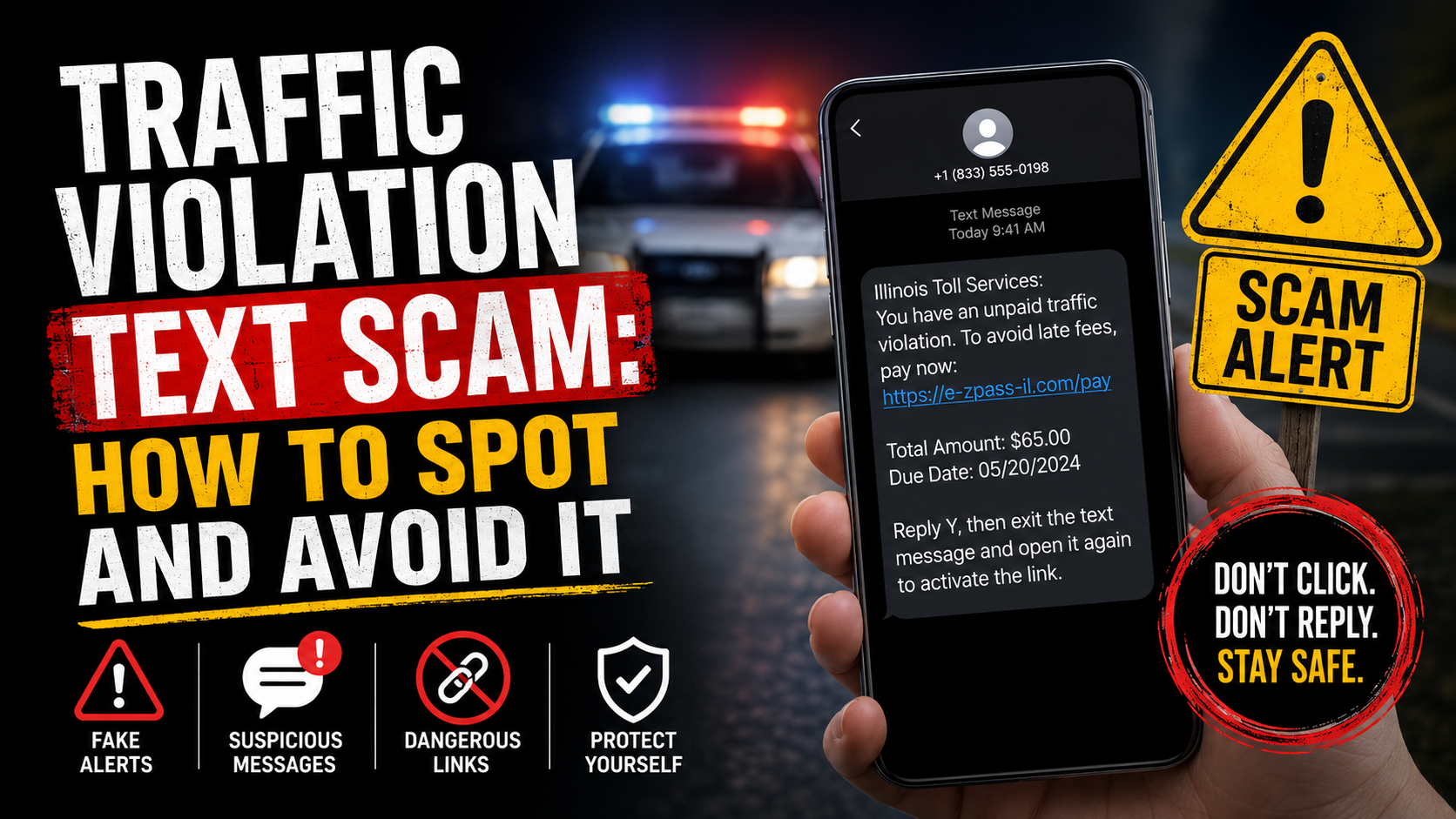
Traffic Violation Text Scam: How to Spot and Avoid It
A text says you have an unpaid fine, a missed court hearing, or a licence about to be suspended. The traffic violation text scam weaponises the fear of legal trouble — here is how it works and how to shut it down.
⚡ Quick Summary — Traffic Violation Text Scam
- What it is: the traffic violation text scam is a smishing fraud — a fake text impersonating courts, the DMV, or toll agencies about an outstanding traffic violation
- Who it targets: sent in bulk to huge numbers of phone numbers — anyone who drives and cannot instantly rule out a speed camera or missed toll is a target
- The core red flag: an unsolicited text about a traffic violation that contains a clickable payment link
- How they take your money: a fake government portal harvests your card details and personal information for fraud and identity theft
- The golden rule: never click a link in a traffic violation text — verify any genuine issue directly with the authority using its official website
⚠️ Already Clicked the Link or Entered Details?
If you have responded to a traffic violation text scam and entered card details, contact your bank immediately to cancel the card. If you entered personal information, place a fraud alert on your credit file. Then jump to the What to Do If You Have Been Targeted section below for the full step-by-step recovery process.
📋 Table of Contents
- What Is the Traffic Violation Text Scam?
- How the Traffic Violation Text Scam Works, Step by Step
- Traffic Violation Text Scam Variants
- Traffic Violation Text Scam Warning Signs
- Real Stories: How It Affects Real People
- What Authorities Say
- How to Protect Yourself
- What to Do If You Have Been Targeted
- Where to Report It
- Frequently Asked Questions
- Related Scam Guides
What Is the Traffic Violation Text Scam
The traffic violation text scam is a smishing fraud — the term used to describe phishing attacks delivered by SMS text message rather than email — in which criminals send fake text messages impersonating traffic enforcement authorities, courts, toll agencies, or government fine collection services. The message typically claims that the recipient has an outstanding traffic fine, an unpaid toll charge, a scheduled traffic court hearing, or a penalty that is about to escalate unless immediate payment or action is taken.
The message always includes a link — either to a fake payment portal that harvests the victim’s card details and personal information, or to a phishing site that mimics a genuine government or court website. When the victim clicks the link and enters their details, those details are captured immediately by the criminals and used to commit payment card fraud, identity theft, or further targeted phishing.
The traffic violation text scam is particularly effective in 2026 because it exploits the growing use of genuine digital traffic enforcement — speed cameras, red light cameras, automated number plate recognition systems, and electronic toll collection — which means receiving an unexpected notification about a traffic violation is increasingly plausible. Many consumers have genuinely received legitimate digital notifications about traffic fines and tolls, which makes them more likely to treat a fraudulent version of the same communication as authentic.
How It Works, Step by Step
Almost every version of the traffic violation text scam follows the same six-stage pattern, from the unsolicited text to the financial and identity damage that emerges later.
Step 1: The Fake Text Message Arrives
The traffic violation text scam begins with an unsolicited text message sent to the victim’s mobile phone. The message is brief and urgent — typically claiming the recipient has an outstanding traffic fine, an unpaid toll, a scheduled court hearing for a traffic violation, or a penalty that will escalate to a much larger amount unless paid within a specified time window. The message may include the recipient’s name — sourced from data breaches — to create a stronger impression of authenticity. Some variants include an attached image that appears to show an official court summons, a traffic camera photograph of a vehicle, or a government fine notice. These images are fabricated but designed to look authentic enough that a brief glance produces a genuine impression of official documentation.
Step 2: The Urgency and Consequences
The traffic violation text scam creates urgency through threatened consequences. Common consequences cited include escalating late payment penalties, driver’s licence suspension, vehicle registration cancellation, warrant issuance for failure to appear at a court hearing, or referral to a debt collection agency. These consequences are all realistic outcomes of genuine unresolved traffic violations — which is precisely what makes them effective as traffic violation text scam urgency triggers. The victim feels they cannot afford to ignore the message in case it is genuine.
Step 3: The Link to a Fake Website
The traffic violation text scam message always includes a link — described as the portal to pay the fine, view the violation details, confirm the court hearing, or dispute the charge. The URL is designed to look official — it may use words like “traffic,” “court,” “fines,” “gov,” “dmv,” or “violations” combined with the apparent name of the relevant state or city. The link leads to a website that closely mimics the visual identity of a genuine government portal — same colours, fonts, and official-sounding language.
Step 4: Harvesting Personal and Payment Information
The fake website at the heart of the traffic violation text scam presents a form asking the victim to enter personal details — name, address, date of birth, driver’s licence number — and payment card information to settle the outstanding fine. Every piece of information entered is captured immediately by the criminals. Card details are used to make fraudulent purchases. Personal information is used for identity theft, further targeted phishing, or sold to criminal data networks. The victim receives a confirmation message suggesting the fine has been paid — and has no immediate indication that anything is wrong.
Step 5: The Financial and Personal Damage Emerges
The impact of the traffic violation text scam typically becomes apparent when the victim notices unauthorised charges on their payment card, receives further fraudulent communications using their personal details, discovers their identity has been used to open new accounts, or — in some cases — later receives a genuine fine notice for the same apparent violation, confirming the original text was fraudulent. By this point, the card details and personal information shared through the scam portal have already been exploited.
Step 6: The Variant With No Real Violation
An important feature of the traffic violation text scam is that the recipient does not need to have committed any genuine traffic violation for the scam to be effective. The messages are sent in bulk to large numbers of phone numbers — many of which belong to people who do drive regularly and therefore cannot immediately rule out the possibility that they were caught by a speed camera or missed a toll payment. This mass distribution strategy means even a small percentage of recipients finding the message plausible generates sufficient victims to make the scam highly profitable.
Traffic Violation Text Scam Variants
5 VariantsThe traffic violation text scam is not a single fraud but a family of related variants — each traffic violation text scam variant works a little differently. These are the five most common.
The Fake Court Hearing Notice
The most alarming traffic violation text scamThe Unpaid Traffic Fine Text
A traffic violation text scam with a price tagThe Toll Road Violation Text
A traffic violation text scam by tollThe Licence Suspension Warning
A traffic violation text scam on your licenceThe Traffic Camera Image Scam
The most sophisticated variantTraffic Violation Text Scam Warning Signs
🚩 Traffic Violation Text Scam Red Flags
- An unsolicited text about a traffic violation you do not recognise. Genuine traffic fine notices are typically sent by post to your registered vehicle address. An unexpected text about a traffic violation — particularly one you have no memory of — is a primary warning sign of the traffic violation text scam.
- A link in the message. Genuine government fine and court notices direct you to contact the issuing authority using a published phone number or to visit a website by typing the URL directly — they do not send clickable links in text messages. Any text about a traffic violation containing a link is a definitive indicator of the traffic violation text scam.
- Extreme urgency and threat of serious consequences. Legitimate traffic fine systems provide reasonable timeframes for payment and dispute. A text claiming your licence will be suspended or a warrant issued unless you pay within hours is a classic pressure tactic.
- A URL that does not match the genuine government website. Check the link destination — without clicking it — by pressing and holding on mobile to preview the URL. Official government traffic enforcement websites use .gov domains in the US and .gov.uk in the UK. Any other domain is a traffic violation text scam phishing site.
- Poor grammar or unusual formatting. While many traffic violation text scam messages are now well-written, some still contain subtle grammatical errors, inconsistent capitalisation, or formatting that differs from genuine government communications.
- The sending number is a standard mobile number. Genuine government agencies send text communications from verified short codes or official sender IDs — not standard mobile phone numbers. A text about a court hearing from a regular mobile number is a traffic violation text scam.
- The message requests payment card details. Genuine government fine portals do not collect card details through a process initiated by a text message link. Any portal reached through a text link that asks for card details is a traffic violation text scam harvesting site.
- You cannot verify the violation independently. Before taking any action, attempt to verify the alleged violation by contacting the relevant authority using a number from their official website. If the authority has no record of it, the text was a traffic violation text scam.
Real Stories
The Commuter Who Clicked the Link
The traffic violation text scam often lands on people who genuinely drive that route. A forty-three-year-old daily commuter received a text claiming he had a scheduled traffic court hearing in three days for a speed camera violation on a road he used regularly. The message included his first name and what appeared to be an official court reference number. Because he did use that road frequently and could not immediately rule out having been caught by a speed camera, he clicked the link — which led to a convincing fake court portal. He entered his driving licence number, home address, date of birth, and credit card details to pay a £120 fine. Within four hours, three unauthorised transactions totalling £680 appeared on his credit card. When he called the court named in the text using a number he found independently, they confirmed no such case existed. The traffic violation text scam had cost him £680 in fraudulent charges and several hours of bank dispute management. His credit card provider ultimately reversed the transactions, but the process took three weeks.
The Parent Who Paid the Fake Fine
The traffic violation text scam also works through small, routine-seeming amounts. A mother of two received a text claiming she had an unpaid toll charge of $14.78 from a motorway toll collection system. The amount was small enough to seem routine, and the text included a link to pay and avoid a $50 late fee. She clicked the link, entered her card details on what appeared to be the toll agency’s website, and paid the $14.78. A week later she saw the toll agency’s name on a list of agencies whose digital systems had been cloned by traffic violation text scam operators. Although she had only paid $14.78, she had given her full card details to the fraudulent site. Over the following two weeks, her card was used for $340 in fraudulent online purchases before she identified the pattern and reported it to her bank. The scam had used a tiny initial payment to harvest card details worth far more to the criminals than the face value of the fake fine.
The Retiree and the Licence Suspension Warning
A sixty-eight-year-old retiree received a text warning that his driving licence was due to be suspended within 48 hours due to three accumulated penalty points from an unresolved speeding violation. He was not aware of any outstanding violation but had received a genuine speeding notice six months earlier which he believed had been resolved. The apparent connection to a real past event made the traffic violation text scam feel highly credible. He clicked the link and entered his driver’s licence number, date of birth, National Insurance number, home address, and bank details on the fake portal. He did not enter card payment details — but the personal information he shared with the traffic violation text scam was sufficient for the criminals to open two credit accounts in his name over the following month. The identity fraud consequences took over eight months to fully resolve, required assistance from a fraud specialist, and caused significant stress and disruption to his retirement.
What Authorities Say
The traffic violation text scam has been specifically flagged by consumer protection bodies and law enforcement on both sides of the Atlantic as one of the most rapidly growing smishing frauds of 2026 — and the traffic violation text scam shows no sign of slowing.
The Federal Trade Commission published a consumer alert specifically about this scam in April 2026, noting a significant spike in reports and warning consumers that text messages about traffic violations containing payment links are almost always fraudulent. The FTC advises consumers to contact the relevant traffic enforcement authority directly using a contact number from the official government website — never using a number or link provided in the suspicious text. Review FTC guidance at consumer.ftc.gov/scams and report at reportfraud.ftc.gov.
The FBI’s Internet Crime Complaint Center has received significant volumes of traffic violation text scam reports and identifies it as part of the broader smishing fraud wave growing consistently since 2023. The FBI advises consumers never to click links in unsolicited text messages claiming to be from government agencies, and to report all suspected smishing attempts at ic3.gov.
Action Fraud in the UK has documented the traffic violation text scam in its UK variant — typically impersonating the DVLA, local council parking enforcement services, or the courts service — and warns that official UK government agencies never send payment links in text messages. Report at actionfraud.police.uk or call 0300 123 2040. Suspicious texts can also be forwarded to 7726 — the UK’s free SMS spam reporting service.
The National Cyber Security Centre in the UK specifically warns about smishing attacks impersonating government services and has published guidance on identifying fraudulent government text messages. Report suspicious websites to the NCSC at ncsc.gov.uk.
How to Protect Yourself
Never Click Links in Unsolicited Traffic Violation Texts
The single most effective protection against the traffic violation text scam is never clicking a link in a text message claiming to be about a traffic violation, toll charge, court hearing, or licence suspension. Regardless of how official the message looks, how urgent the language is, or whether you can imagine having committed the alleged violation — do not click the link. This rule defeats every variant of the traffic violation text scam completely. If you genuinely have an outstanding traffic issue, you will be able to find and resolve it through the official channels described below.
Verify Independently Through Official Channels
If you receive a text about a traffic violation and want to verify whether it is genuine, contact the relevant authority directly using contact details from the official government website — not from the text message. In the US, this means contacting your state’s DMV, the relevant court, or the toll collection agency using their published phone number or official website. In the UK, contact the DVLA, the relevant local council, or the courts service directly. A genuine issue will be resolvable through official channels. The traffic violation text scam does not survive this verification step — because the violation it describes does not exist.
Check the URL Before Entering Any Information
If you have already clicked a link before reading this guide, check the URL in your browser’s address bar before entering any information. Genuine US government traffic enforcement websites use .gov domains; genuine UK government websites use .gov.uk domains. Any other domain — regardless of how official the site looks — is a phishing site. Close the browser immediately without entering anything and report the URL to the relevant authority. This is the same discipline covered in our guide to phishing scams.
Forward the Text to 7726 and Report It
In the UK, forward any traffic violation text scam message to 7726 — the free SMS spam reporting service. This costs nothing and helps mobile networks identify and block the fraudulent sending numbers. In the US, forward the text to SPAM (7726) and report it to the FTC at reportfraud.ftc.gov. Your report contributes to the identification and disruption of the criminal networks operating the traffic violation text scam.
Monitor Your Accounts if You Have Already Clicked
If you clicked a link in a suspected traffic violation text scam but did not enter any information, monitor your device for unusual behaviour and consider running a security scan. If you entered any personal information — even without making a payment — monitor your credit report for signs of identity fraud and contact your bank to alert them to a potential data exposure. If you entered payment card details, contact your bank immediately to cancel the card and dispute any fraudulent transactions.
What to Do If You Have Been Targeted
If you have already clicked the link or entered details into a traffic violation text scam site, act quickly to limit the damage. The steps below give you the best chance of limiting the damage.
Contact your bank immediately
If you entered payment card details on a phishing site, call your bank or card provider immediately. Report that your card details have been compromised through a fraudulent website and request a card cancellation and replacement. Ask your bank to review recent transactions and dispute any unauthorised charges. Speed is critical — card details are typically tested through small test transactions within minutes of being submitted to a traffic violation text scam harvesting site.
Report to the FTC or Action Fraud
US victims should report to the FTC at reportfraud.ftc.gov and the FBI at ic3.gov. UK victims should report to Action Fraud at actionfraud.police.uk and to the NCSC. Provide the phone number that sent the text, the URL of the fake website, and details of any information entered or payment made.
Place a fraud alert on your credit file
If you shared personal identity information — driver’s licence number, date of birth, National Insurance or Social Security number — place a fraud alert on your credit file immediately. In the US, contact Equifax, Experian, and TransUnion; in the UK, contact Experian, Equifax, and TransUnion directly. A fraud alert notifies lenders to take extra steps to verify identity before opening new accounts.
Report the phishing website
Report the fake website URL to Google Safe Browsing at safebrowsing.google.com and to the NCSC. These reports contribute to having the traffic violation text scam website flagged in browsers and search engines — preventing other consumers from landing on the site through search results or by clicking the same link in subsequent scam texts.
Warn other drivers
The traffic violation text scam spreads by reaching as many phone numbers as possible. Tell drivers in your family and community what happened — particularly those who commute regularly or use toll roads, who are the primary targets. A quick warning can stop someone else clicking the same link.
Where to Report It
Reporting the traffic violation text scam helps authorities block fraudulent numbers and take down the phishing sites behind the traffic violation text scam. Use the body that matches your country and situation.
Frequently Asked Questions
Think You have Been Scammed?
Act fast — contact your bank, then report it through the official channels.


One response to “Traffic Violation Text Scam: How to Spot and Avoid It”
[…] You are told your refund will be cancelled, returned to the treasury, or forfeited unless claimed within the stated window. For someone who has been waiting for a legitimate refund, the threat of losing money they are owed is particularly motivating. This urgency is deliberately calibrated to prevent you from pausing to verify the message independently — the same pressure tactic used in the traffic violation text scam. […]