- Introduction
- What Is a Romance Scam?
- How Romance Scams Work Step by Step
- Types of Romance Scams to Know
- Romance Scam Warning Signs Everyone Must Know
- Real Stories: How the Romance Scam Affects Real People
- What Authorities Say About Romance Scams
- How to Protect Yourself from Romance Scams
- What to Do If You Have Been Targeted by a Romance Scam
- Conclusion
- Related Articles
Introduction
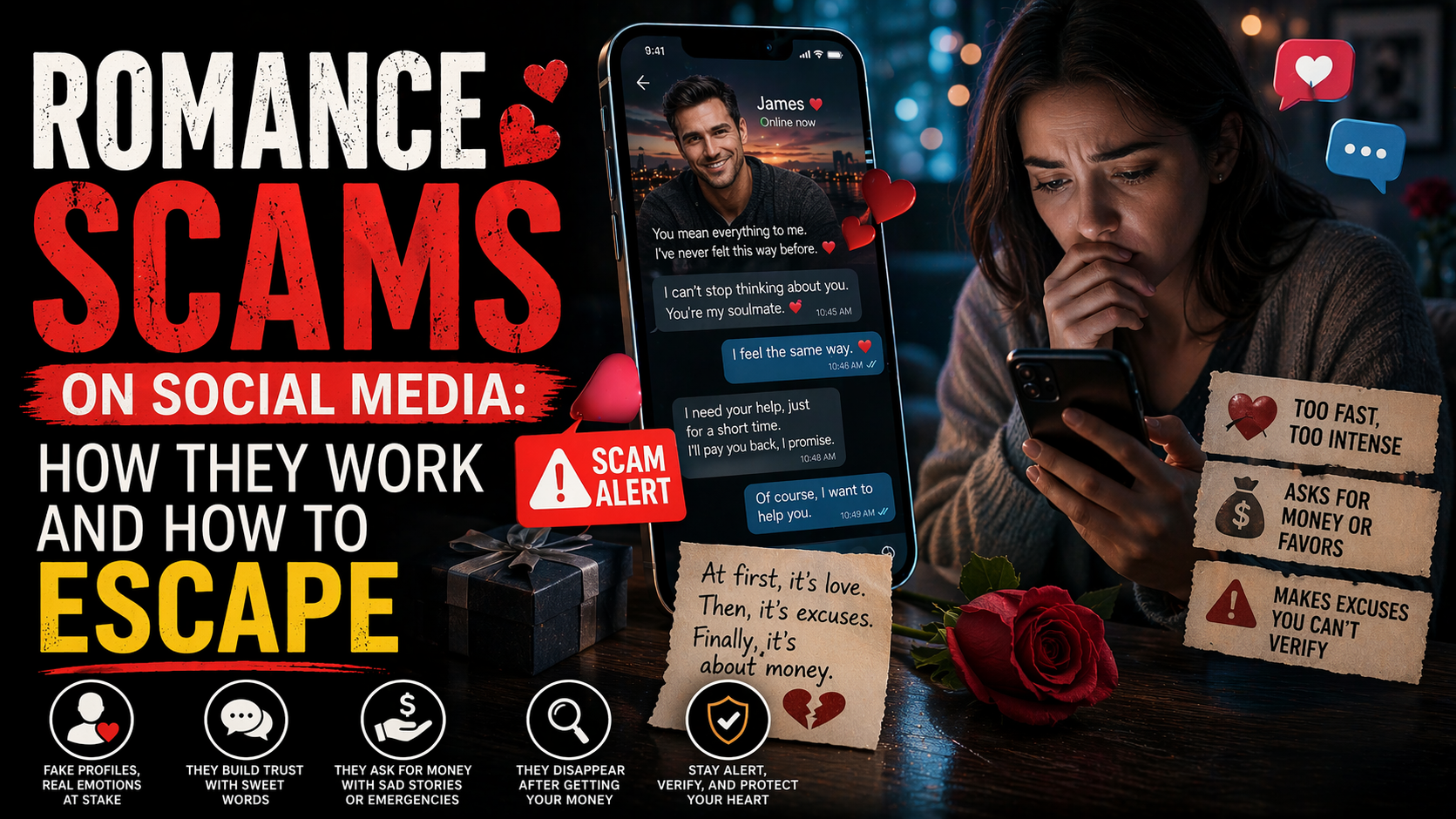
The romance scam is one of the most emotionally devastating and financially destructive forms of fraud targeting people across the world today. Criminal networks operating through dating apps, social media platforms, and messaging services create elaborate fake identities, invest weeks or months building what appear to be genuine romantic relationships, and then systematically exploit the trust and emotional attachment they have cultivated to steal vast sums of money from their victims. If you have been searching for information about romance scams, this comprehensive guide will give you everything you need to know to protect yourself, recognise the warning signs, and escape if you are already involved in what may be a fraudulent relationship.
The financial losses caused by the romance scam are staggering. In the United States alone, romance scammers extract an estimated $1.3 billion from victims every year — and that figure accounts only for what is reported. Research suggests that fewer than one in three scam victims ever report the crime to authorities, meaning the true scale of romance scam losses is dramatically higher. The emotional harm inflicted by the romance scam is equally significant and in many ways more enduring — victims do not simply lose money, they lose what they believed was a genuine, loving relationship, and must process that grief alongside the practical consequences of financial devastation.
What makes the romance scam uniquely dangerous is that it targets the most fundamental human need — the desire for connection, love, and companionship. Unlike fraud that exploits greed or fear, the romance scam exploits hope. The criminals who carry out these scams are expert psychological manipulators who research their targets extensively, invest genuine time and emotional labour in building the fraudulent relationship, and deploy sophisticated techniques to maintain the victim’s emotional investment even when warning signs begin to appear. The romance scam is not a crude or opportunistic crime — it is a calculated, professional operation carried out by organised criminal networks that operate at enormous scale.
This guide from Scammers Expose provides a thorough breakdown of the romance scam: the specific tactics used by fraudsters, how these scams unfold step by step, the warning signs that can protect you before serious financial harm occurs, real accounts from affected victims, what authorities say about this widespread threat, and the concrete steps you should take if you believe you have been targeted. Understanding the romance scam fully is the most powerful protection available to anyone navigating online relationships.
What Is a Romance Scam?
A romance scam is a confidence fraud in which a criminal establishes a fake online romantic relationship with a victim for the purpose of stealing money, extracting personal information, or manipulating the victim into participating in other criminal activities. The criminal uses a fabricated identity — typically an attractive, successful, and emotionally appealing persona built using stolen photographs, AI-generated images, and carefully constructed backstories — to cultivate genuine emotional attachment in the victim before exploiting that attachment for financial gain.
The romance scam operates across virtually every online platform where people connect — dating apps, social media sites, messaging platforms, online forums, and even professional networking sites. The scammer’s initial contact may be through a direct message on a dating app, an unexpected social media connection request, an unsolicited text message claiming to have reached the wrong number, or even through a fake job listing. The common thread across all variants of the romance scam is the deliberate construction of emotional intimacy as a tool of exploitation.
The FBI identifies the romance scam as one of the most prevalent and financially damaging fraud schemes operating globally, noting that the criminals who carry out these scams are experts at what they do — they are genuine, caring, and believable in ways that make their fraudulent nature extremely difficult to detect until significant financial and emotional harm has already occurred. The FBI emphasises that anyone can fall victim to a romance scam, regardless of age, education, intelligence, or life experience.
How Romance Scams Work Step by Step
Understanding precisely how the romance scam operates at each stage makes it significantly easier to identify and resist before serious harm occurs.
Step 1: Creating the Fake Identity
The romance scam begins with the criminal constructing a convincing fake identity. Profile photographs are sourced from stolen social media images, modelling photographs, or increasingly from AI-generated imagery that creates an attractive face that does not belong to any real person and therefore cannot be identified through reverse image search. The persona created for the romance scam is typically highly appealing — the scammer claims to be a successful professional such as a doctor, engineer, military officer, or international businessperson, which provides a plausible reason for being unable to meet in person and creates an impression of financial stability that makes later requests for money seem incongruous and therefore more believable.
Criminal networks operating romance scams develop detailed scripts and personas that have been refined through extensive experience of what works. They research their target’s social media profiles and dating app information to understand the victim’s interests, values, and emotional vulnerabilities, then construct a persona specifically tailored to appeal to that individual. This level of personalised targeting is what distinguishes the sophisticated romance scam from more generic fraud and makes it so difficult for victims to recognise as fraudulent.
Step 2: Establishing Contact and Building Initial Trust
The romance scam operator makes initial contact through whichever channel is most likely to reach the target. On dating apps, the fake profile matches with and messages the victim. On social media, a connection request is followed by a friendly message. The opening communications are warm, interested, and flattering — the scammer quickly demonstrates what appears to be genuine interest in the victim’s personality, life, and values. Early in the romance scam, the criminal often asks to move communication off the original platform to a private messaging app such as WhatsApp or Telegram, removing the fraud detection monitoring that platforms like dating apps have in place.
Step 3: Love Bombing and Rapid Emotional Investment
Once communication is established, the romance scam operator employs a technique known as love bombing — an overwhelming display of affection, attention, and romantic intensity that accelerates the emotional development of the relationship far beyond what would be natural. The scammer contacts the victim multiple times daily, expresses strong feelings of love and connection very early in the relationship, discusses the future together, and makes the victim feel uniquely special and deeply understood. The rotation of multiple scam operators all presenting as the same persona means the victim can receive attention at any hour of the day or night, creating an illusion of devotion and investment that is extremely difficult to resist.
Step 4: Avoiding In-Person Verification
A defining characteristic of every romance scam is the consistent avoidance of any form of genuine real-time verification. The scammer never meets in person — always having a reason why they cannot: they are working abroad on an oil rig, serving in the military overseas, on a business trip in another country, or facing immigration complications. They avoid video calls, claiming a broken camera, poor internet connection, or work restrictions. In some cases, romance scam operators use pre-recorded video clips or deepfake technology to simulate video calls, but these are brief and controlled to avoid revealing the deception. The inability to meet or genuinely verify the person’s identity in real time is a fundamental feature of every romance scam.
Step 5: Isolation from Support Networks
As the romance scam progresses, the criminal often attempts to isolate the victim from friends and family who might notice warning signs and raise concerns. The scammer may suggest that the relationship is so special and unique that others would not understand it, encourage the victim to keep the relationship private, or create a sense that the victim’s existing relationships are less important than the connection with the scammer. This isolation removes the protective influence of trusted people who could otherwise help the victim recognise and escape the romance scam.
Step 6: The Financial Request
After sufficient trust and emotional investment have been established — sometimes over weeks, sometimes over months — the romance scam operator makes the first financial request. This is almost always framed as an emergency or urgent need: a medical crisis requiring immediate funds, a business deal that will collapse without a temporary loan, legal trouble that needs a payment to resolve, travel costs to finally come and visit the victim, or customs fees to release money or valuables being held at a border. The request exploits the deep emotional bond the victim now feels — it is framed not as a stranger asking for money, but as someone the victim loves asking for help in a genuine crisis.
Payment methods requested in romance scams are consistently those that are difficult or impossible to reverse — wire transfers, cryptocurrency, gift card codes, or payment apps. Once funds are sent through these channels, recovery is extremely rare. After the initial payment, further requests typically follow, each with a new emergency or complication, extracting increasing amounts from the victim until the relationship becomes unsustainable or the victim runs out of money to send.
Types of Romance Scams to Know
The Classic Dating App Romance Scam
The traditional romance scam operates through dating platforms — Tinder, Bumble, Hinge, Match, and others — where fake profiles with stolen or AI-generated photographs match with and cultivate relationships with victims over days, weeks, or months before making financial requests. This remains the most widespread form of romance scam and affects people of every age, background, and demographic.
The Pig Butchering Romance Scam
Pig butchering is a sophisticated variant of the romance scam that combines romantic manipulation with cryptocurrency investment fraud. The scammer builds a romantic relationship and then introduces a fake cryptocurrency investment platform, encouraging the victim to invest increasing amounts of money while showing fabricated returns. Once the victim has invested a significant sum, the scammer and the platform disappear, taking all deposited funds. This variant of the romance scam is responsible for billions of dollars in annual losses and is predominantly operated by large organised criminal networks.
The Military Romance Scam
In the military romance scam, the criminal claims to be a member of the armed forces stationed overseas. The military persona provides a ready explanation for why meetings are impossible, why video calls are restricted, and why money transfers are needed for everything from phone credit to emergency medical treatment. The association with military service also creates a powerful impression of trustworthiness and honour that makes victims less likely to apply scepticism to the relationship.
The Sextortion Romance Scam
In this particularly distressing variant of the romance scam, the criminal cultivates a romantic or flirtatious relationship and encourages the victim to share intimate photographs or participate in explicit video calls. The criminal records or saves this content without the victim’s knowledge and then uses it as blackmail material — threatening to send the content to the victim’s contacts, family members, or employer unless payment is made. The financial demands in sextortion romance scams are compounded by the profound emotional distress caused by the threat of exposure.
The Wrong Number Romance Scam
An increasingly common entry point for the romance scam is the “wrong number” text message — the victim receives a friendly message apparently intended for someone else and the scammer uses the resulting conversation to establish a connection. Because the victim believes they have been contacted by accident rather than targeted, their guard is significantly lower than it would be in response to an unsolicited approach on a dating platform. The relationship then develops in the same way as any other romance scam, eventually leading to financial requests.
Romance Scam Warning Signs Everyone Must Know
Recognising the romance scam before significant financial and emotional investment has occurred is far better than attempting to recover from the consequences. These are the specific warning signs that every person should know:
- The relationship progresses unusually fast: If someone you have never met in person is expressing deep love, discussing marriage, or describing a profound connection within days or weeks of first contact, treat this as a significant warning sign of a romance scam. Genuine relationships develop at a natural pace — manufactured emotional intensity is a deliberate manipulation technique.
- They always have an excuse to avoid meeting or video calling: Every romance scam involves a persistent inability to meet in person or engage in spontaneous, uncontrolled video communication. Broken cameras, poor internet connections, military restrictions, overseas work assignments, and travel complications are the standard excuses. If someone you have been communicating with for months has never once been able to meet you or video call you naturally, this is a categorical warning sign.
- Their profile photographs look too perfect: Romance scam profile photographs are typically of professionally photographed models or AI-generated faces — unusually attractive, with a polished, editorial quality that does not match the informal nature of a genuine dating or social media profile. Conduct a reverse image search of any profile photograph to check whether it appears elsewhere under a different name.
- They ask you to move communication off the platform: Requests to move conversations from dating apps or social media platforms to private messaging apps like WhatsApp or Telegram — made early in the relationship — are a standard feature of the romance scam, removing the platform’s fraud monitoring from the interaction.
- Their stories contain inconsistencies: Romance scam operators typically manage multiple fake relationships simultaneously and may lose track of details they have shared with individual victims. Inconsistencies in biographical details, contradictions in stories about their life and work, or details that simply do not add up are indicators of a fabricated persona.
- They ask for money for any reason: No matter how convincing the emergency, how compelling the story, or how deep the apparent love — any financial request from someone you have never met in person should be treated as a probable romance scam. The FTC is explicit: never send money to someone you have only met online, regardless of how long you have been communicating or how genuine the relationship feels.
- They try to isolate you from friends and family: If your online romantic interest discourages you from discussing the relationship with people close to you or suggests that others would not understand your connection, this is a manipulation tactic used in the romance scam to remove the protective influence of people who might raise concerns.
- Your bank contacts you with concerns: Financial institutions are often the first external party to notice patterns consistent with romance scam financial transfers. If your bank contacts you to express concern about transactions you are making, this should be treated as a serious warning sign that requires immediate reassessment of the relationship.
Real Stories: How the Romance Scam Affects Real People
The human reality of the romance scam is one of compounded loss — financial devastation combined with the grief of losing what felt like a genuine loving relationship. The following anonymised accounts illustrate the real-world consequences of these frauds.
Story 1: The Widow Who Lost Her Life Savings
A woman in her late fifties, recently widowed and experiencing profound loneliness, was contacted through a popular social media platform by a man who presented himself as a widowed American engineer working on an overseas construction project. Over four months, they exchanged messages daily — he was attentive, emotionally intelligent, and consistently loving in a way that felt entirely genuine. He spoke about returning home to be with her and discussed their future together in detail.
The first financial request came in the form of an emergency — his wages had been delayed and he needed money to cover urgent medical bills for a worker on his site. She transferred £3,000. Further emergencies followed over the next three months — legal fees, customs charges for equipment, a problem with his bank account. By the time a family member raised concerns and she contacted the police, she had transferred £67,000 — the entirety of her late husband’s life insurance payout. The man she had spent four months falling in love with had never existed. The romance scam had taken everything she had.
Story 2: The Professional Who Became a Money Mule
A successful professional in his forties met a woman through a dating app who claimed to be a doctor working with an international health organisation. After two months of daily communication, she explained that she had been paid in overseas bank transfers that she could not access from her current location and asked if he would allow her to transfer a sum into his account temporarily, which he could then forward to her.
He agreed — not understanding that this made him a money mule in a money laundering operation connected to the romance scam network. When his bank identified and reported the suspicious transactions, he faced not only the realisation that his relationship was fraudulent but also a serious investigation into his own financial conduct. He had to demonstrate to law enforcement that he had been a victim rather than a willing participant. The romance scam had not only stolen the money he transferred but had potentially put his professional career and financial reputation at risk.
Story 3: The Young Person Targeted Through Instagram
A twenty-three-year-old was approached through Instagram by someone who appeared to be a successful young entrepreneur. The communication was flirtatious and exciting — the apparent entrepreneur showed apparent evidence of a wealthy, interesting life and expressed consistent romantic interest. After six weeks, the entrepreneur mentioned a highly profitable short-term investment opportunity and suggested they invest together as a romantic gesture.
The victim invested £4,500 on a platform the scammer recommended. The platform showed impressive returns. She was encouraged to invest more — she borrowed £8,000 from her parents to do so. When she attempted to withdraw her apparent profits, the platform demanded a withdrawal fee. By this point she had recognised the romance scam — but her total loss of £12,500, the damage to her relationship with her parents, and the emotional betrayal of what she had believed was a genuine romantic connection compounded the harm far beyond the financial loss alone.
What Authorities Say About Romance Scams
Law enforcement and consumer protection authorities worldwide have dedicated significant resources to raising awareness about the romance scam threat and providing support to victims.
The Federal Bureau of Investigation maintains a dedicated romance scam resource page at fbi.gov and accepts reports through the Internet Crime Complaint Center at ic3.gov. The FBI emphasises that romance scammers are expert manipulators and that anyone can fall victim — falling for a romance scam is not a reflection of intelligence or naivety but of human nature and the skill of professional fraudsters.
The Federal Trade Commission accepts romance scam reports at reportfraud.ftc.gov and maintains consumer guidance specifically addressing the tactics used in romantic fraud. The FTC emphasises that mixing online dating with investment advice is a hallmark of the romance scam and that anyone who promises financial returns through a relationship met online should be treated as a probable scammer.
Action Fraud in the United Kingdom accepts romance scam reports at actionfraud.police.uk or by calling 0300 123 2040. The National Crime Agency has noted that romance scams are among the fastest-growing categories of cybercrime in the UK, with losses increasing year on year as criminal networks expand their operations and refine their techniques.
Law enforcement agencies globally have acknowledged that many romance scam operations are run by large transnational criminal organisations, some of which force trafficked individuals to conduct the scams from secure compounds. This means that some apparent scammers are themselves victims of serious human rights abuses — a complexity that does not diminish the harm caused to romance scam victims but illustrates the vast criminal ecosystem that this form of fraud sustains.
How to Protect Yourself from Romance Scams
Never Send Money to Someone You Have Not Met in Person
This is the single most important rule of protection against the romance scam: never send money to someone you have only communicated with online, regardless of how long the relationship has existed, how genuine it feels, or how urgent the apparent need. This rule has no exceptions. The romance scam is specifically designed to make you feel that this person is different — that the depth of your connection justifies breaking this rule. It does not. No genuine online romantic relationship requires financial transfers before a confirmed in-person meeting has taken place.
Conduct a Reverse Image Search
Save the profile photographs of anyone you meet online and conduct a reverse image search using Google Images or TinEye. If the photographs appear on other websites under a different name or in contexts inconsistent with what the person has told you about themselves — modelling portfolios, other social media profiles, stock image libraries — this is a strong indicator of a romance scam. Many romance scam operations use the same sets of stolen photographs across multiple fake profiles, making reverse image search a highly effective identification tool.
Talk to Someone You Trust
If you have developed an online relationship with someone you have not met in person, share the details with a trusted friend or family member and genuinely listen to their perspective. People who are not emotionally invested in the relationship will often notice warning signs that are invisible to the person inside it. If people close to you express concern about your online relationship, take those concerns seriously rather than dismissing them as jealousy or misunderstanding. The romance scam deliberately creates a sense that the relationship is so special that others cannot understand it — recognising this as a manipulation tactic is essential to maintaining protective perspective.
Go Slowly and Ask Specific Questions
Resist the pace that the romance scam operator is setting. Ask specific, verifiable questions about their life, work, and circumstances — and pay attention to inconsistencies, evasiveness, or answers that change over time. Ask to arrange a spontaneous video call at a time the other person cannot prepare for. Ask to be shown their workplace or home environment through a live video. Genuine people can accommodate these reasonable requests — romance scam operators cannot do so without exposing the fraud.
Be Cautious About What You Share Online
Romance scam operators extensively research their targets’ social media profiles before making contact, using publicly available information to construct a persona specifically tailored to appeal to that individual. Reviewing and tightening your social media privacy settings reduces the information available to potential scammers and makes it harder for them to build a convincing tailored approach. Never share personal identification information, financial account details, or intimate content with someone you have not met in person and independently verified as genuine.
What to Do If You Have Been Targeted by a Romance Scam
Stop All Contact Immediately
If you recognise that you are involved in a romance scam, stop all communication with the scammer immediately. Do not warn them that you have identified the fraud — doing so may prompt them to make further demands or threats before disappearing. Block the person on every platform and channel through which you have communicated. The emotional difficulty of ending contact with someone you have developed feelings for, even knowing the relationship is fraudulent, should not be underestimated — the feelings experienced in a romance scam are real, even though the other person was not.
Contact Your Bank Immediately
If you have made any payments as a result of a romance scam, contact your bank or card provider immediately. Report that you were deceived into making fraudulent transfers and ask them to take any action available to recover or block funds. If you provided account details to the scammer or received any transfers on their behalf, inform your bank immediately — you may have been used as a money mule and your bank needs to know to protect your account and your legal position.
Report to Authorities
In the UK, report the romance scam to Action Fraud at actionfraud.police.uk or by calling 0300 123 2040. In the US, report to the FBI’s IC3 at ic3.gov and the FTC at reportfraud.ftc.gov. In Australia, report to Scamwatch at scamwatch.gov.au. Also report the fake profile to the dating platform or social media site where the scammer made contact — platforms can remove the fraudulent profile and alert other potential victims.
Do Not Be Ashamed — Seek Support
Shame and embarrassment are among the most significant barriers to romance scam victims seeking help and reporting the crime. The stigma associated with having been deceived in a romantic context causes many victims to suffer in silence, which compounds the emotional harm and reduces the likelihood of financial recovery. It is essential to understand that romance scam victims have been targeted and manipulated by professional criminals using sophisticated psychological techniques refined over years of operation. Falling victim to a romance scam is not a reflection of intelligence, weakness, or naivety — it is a consequence of trusting someone who was specifically trained to be trustworthy. Speaking with trusted individuals and, where needed, a professional counsellor or support service can help process the complex grief and betrayal that romance scam victims experience.
Conclusion
The romance scam is among the most cruel and psychologically sophisticated forms of fraud in existence because it exploits the most universal of human needs — the desire to be loved and to love in return. The criminal networks that operate romance scams are professional, experienced, and remorseless — they invest significant resources in making their fraudulent relationships feel entirely real because the more real the relationship feels, the more money the victim will be willing to send.
The most powerful protection against the romance scam is awareness of how it works, combined with one unwavering rule: never send money to someone you have not met in person and independently verified as genuine. Every other warning sign, every other protective measure, ultimately serves this single principle. If you hold to it — regardless of how convincing the emergency, how deep the apparent love, or how long the relationship has continued — the romance scam cannot succeed.
If this article helped you understand the romance scam, please share it with anyone you know who is navigating online relationships — particularly those who may be experiencing loneliness, recent loss, or other emotional vulnerabilities that romance scam operators deliberately target. Visit our news section for the latest scam alerts and consumer protection advice. For more insights into fraud and online scams, visit Scammers Expose.
Related Articles
If you found this article helpful, you may also want to read these related scam awareness guides: